Guides / Applications
Ceramic Thermocouple Tubes and Heater Parts: Alumina, Mullite and SiC Compared
October 15, 2026
Inside a furnace, the temperature sensor and the heating element sit among hot gas, vapours, sometimes molten material and often several hundred degrees of temperature change per hour. Ceramic is the only practical material for both the protection around the sensor and many parts of the heater itself.
This guide covers the main ceramic parts in a furnace temperature system: protection tubes, thermocouple insulators and heater supports. It sets out which material fits which job and what usually goes wrong.
The parts
- Protection tube. A closed-end tube that holds the thermocouple. It keeps the atmosphere, vapour and any liquid from reaching the wires. Sizes commonly range from a few millimetres to about 25 mm outer diameter, and from a few centimetres up to over a metre in length.
- Insulator. An extruded tube with one, two or four bores that keeps thermocouple wires separate and stops them shorting.
- Heater former or bobbin. A tube or a grooved body that carries the resistance wire in a heater.
- Element support and spacer. Beads, hooks and posts that hold heating elements in place.
- End cap and plug. Close the ends of heater tubes or probes.
- Crucible and boat. Not strictly sensor parts, but made from the same materials and for the same temperatures.
Choosing the ceramic
| Material | Typical maximum use | Gas tightness | Thermal shock | Typical use |
|---|---|---|---|---|
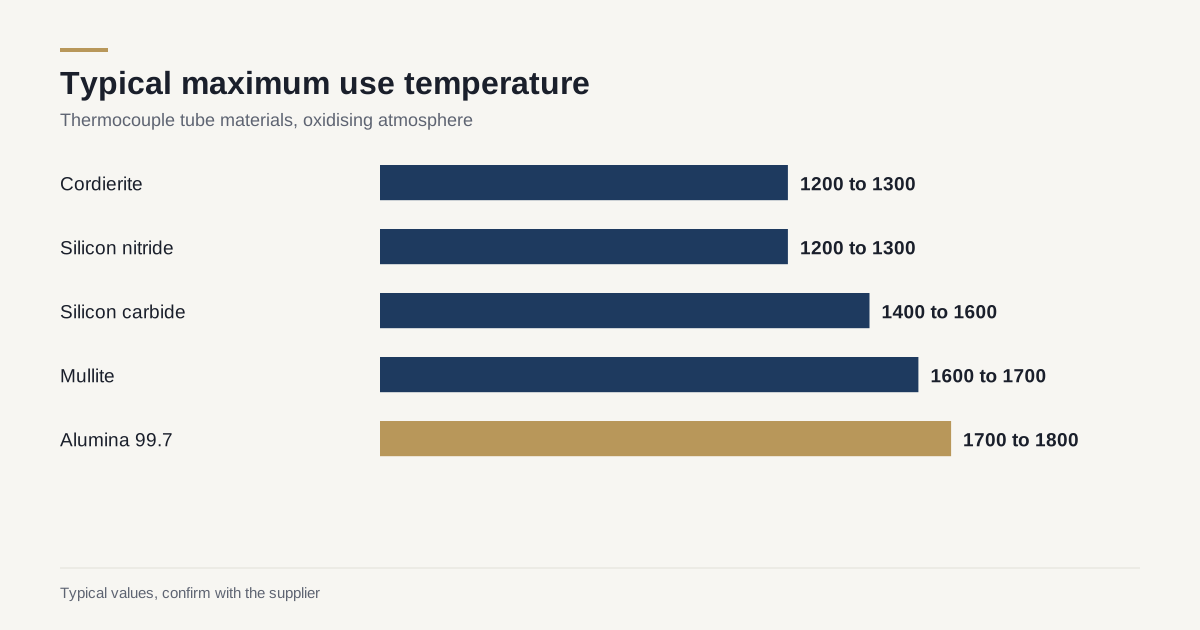
| Alumina, 99.7 percent | About 1700 to 1800 degrees C | Gas tight when dense | Fair, needs slow ramps | Protection tubes, insulators |
| Alumina, 96 to 99 percent | About 1500 to 1650 degrees C | Gas tight when dense | Fair | General furnace parts |
| Mullite | About 1600 to 1700 degrees C | Gas tight in dense grades | Better than alumina | Protection tubes in cycling furnaces |
| Cordierite | About 1200 to 1300 degrees C | Often porous | Very good | Heater formers, low temperature parts |
| Silicon carbide | About 1400 to 1600 degrees C in air | Dense grades gas tight | Very good | Molten metal, abrasive and fast cycling duty |
| Silicon nitride | Up to about 1200 to 1300 degrees C in air, higher in inert | Dense | Excellent | Molten aluminium and non-ferrous metals |
These are typical maxima and depend on atmosphere, grade and loading. Always check the producer’s datasheet and apply a margin. For the choice between cordierite and mullite in thermal cycling, see cordierite vs mullite for thermal cycling.
Gas tightness and purity
A protection tube must be gas tight, or the furnace atmosphere reaches the thermocouple wires and drifts the reading. That calls for a dense body with no open porosity through the wall. Alumina and dense mullite grades are sold as gas tight. Porous grades are not.
Purity matters for noble-metal thermocouples (types R, S and B, platinum based). Silica, iron or other impurities in the ceramic can contaminate platinum wires at high temperature, especially in a reducing atmosphere, and cause the reading to drift. For platinum thermocouples, high purity alumina is the standard. For cheaper base-metal thermocouples, a lower purity may be acceptable.
For other points on matching material to temperature and atmosphere, see choose a ceramic by property.
How tubes are made
Long thin tubes are usually made by extrusion or isostatic pressing. Extrusion pushes a plastic ceramic paste through a die to form a continuous tube, which is cut and fired. It suits open tubes and multi-bore insulators in volume. Isostatic pressing, around a mandrel in a flexible mould, makes closed-end tubes and larger diameters with uniform density. See dry pressing vs isostatic pressing for how the two compare.
Fired tubes shrink by around 15 to 20 percent, so as-fired tolerances are loose, often around plus or minus 1 to 2 percent of the dimension. Straightness is a main concern on long tubes. Where fit matters, shops grind the ends and sometimes the outer diameter. See sintering shrinkage explained.
Thermal shock: the main cause of breakage
Most protection tube failures come from sudden temperature change. A cold tube pushed into a hot furnace gets a hot outside and a cold inside, and cracks. A hot tube pulled into room air does the same in reverse.
Ways to reduce it:
- Preheat in stages. Hold the tube at the mouth of the furnace for a time before pushing it in.
- Slow ramps. Heat and cool at a rate the supplier recommends, especially through the first few hundred degrees.
- Support the tube. Let it expand freely and avoid clamping it rigidly at both ends.
- Match the material to the cycle. Mullite or silicon carbide for fast cycling, alumina for high temperature.
- Avoid contact with cold liquids or draughts.
See ceramic thermal shock testing for test methods and typical limits.
Heater parts
For resistance heaters, ceramic formers and supports do four jobs: hold the element, insulate it electrically, keep it from touching other parts and survive the temperature.
- Alumina is the standard for higher temperatures and strength.
- Cordierite is common for lower temperature heaters and heating appliances, thanks to its shock resistance and low cost.
- Steatite serves in lower temperature domestic and industrial heaters. See steatite and forsterite for electrical insulators.
- Mullite and silicon carbide suit hot zones and aggressive atmospheres.
Electrical insulation drops as temperature climbs, so for a heater former check resistivity at the operating temperature. Watch for chemical reactions between the element and the ceramic: some element alloys react with silica-rich bodies at high temperature.
Installation and handling
Many tube failures start before the furnace is lit.
- Store tubes flat and supported. A long thin tube stored on end or on a single point can bow or break.
- Inspect before use. Look along the tube for hairline cracks and chips, and ring it lightly: a sound tube rings clearly. See detecting cracks in ceramics.
- Fit a gas-tight seal at the cold end. A fitting with a compression gland or a ceramic cement seals the tube at the furnace wall. A leak here lets air in even when the tube is sound.
- Leave room for the thermocouple. Wires and insulators must slide in without force. A bent bead or a rubbing wire adds stress and can crack the insulator.
- Do not reuse a contaminated tube with a different thermocouple type. Material from earlier use can migrate in the pores or on the surface.
A worked example
A heat treat shop measures furnace temperature with a type S thermocouple in a 99.7 percent alumina protection tube. After a few months the readings drift low, and the furnace controller compensates by running hotter. The tubes look fine from the outside. When one is cut open, the platinum wire is brittle and the inside surface is discoloured. The tube was sound, but the multi-bore insulator inside it was a lower purity grade with a silica content that attacks platinum in the shop’s reducing atmosphere. The fix is not a better outer tube. It is a high purity insulator throughout, and a drift check against a reference sensor on a set schedule.
The lesson is that a thermocouple assembly is a system. Every ceramic in contact with the wires must match the wire type and the atmosphere, not only the tube on the outside. See which alumina purity do you need for how grades differ.
What goes wrong
- Cracking from thermal shock.
- Atmosphere drift from a porous or cracked protection tube.
- Contamination of platinum wires from low purity ceramic.
- Devitrification and sag in lower purity bodies at the top of their range.
- Reaction with molten metal or slag at the immersion line.
- Breakage from side load when a long tube is clamped at an angle.
Checklist for the RFQ
- Maximum and continuous temperature, atmosphere and any liquid contact.
- Thermocouple type, which sets the purity requirement.
- Tube outer and inner diameter, length and closed or open end.
- Gas tightness requirement and the test.
- Number and size of bores for insulators.
- Straightness and end finish.
- Thermal cycle: ramp rates and number of cycles.
- Quantity and delivery.
To find shops that supply furnace tubes and heater parts, send a drawing and the duty through the RFQ page.
Frequently asked questions
What is the difference between a protection tube and an insulator?
A protection tube is a closed or open ended outer tube that shields the thermocouple from the furnace atmosphere and the load. An insulator is a tube with one or more bores that holds the thermocouple wires apart inside it. Many probes use both.
Which ceramic should I use for a high temperature thermocouple tube?
High purity alumina, 99.7 percent or better, is the usual choice above about 1200 degrees C when gas tightness is needed. Mullite handles thermal shock a little better with a lower temperature limit. Silicon carbide suits molten metal and abrasive duty.
Why do alumina thermocouple tubes crack?
Mostly from thermal shock when a cold tube goes into a hot furnace or a hot tube meets cold air. Preheating the tube in steps, supporting it so it can expand and avoiding side load all reduce cracking.
Need a quote for this part?
Send the drawing. We match you with up to 3 shops that grind this grade and reply within 24 business hours.
Get matched with a ceramic shop