Guides / Process
Dry Pressing or Isostatic Pressing: How the Blank Gets Its Shape
October 19, 2026
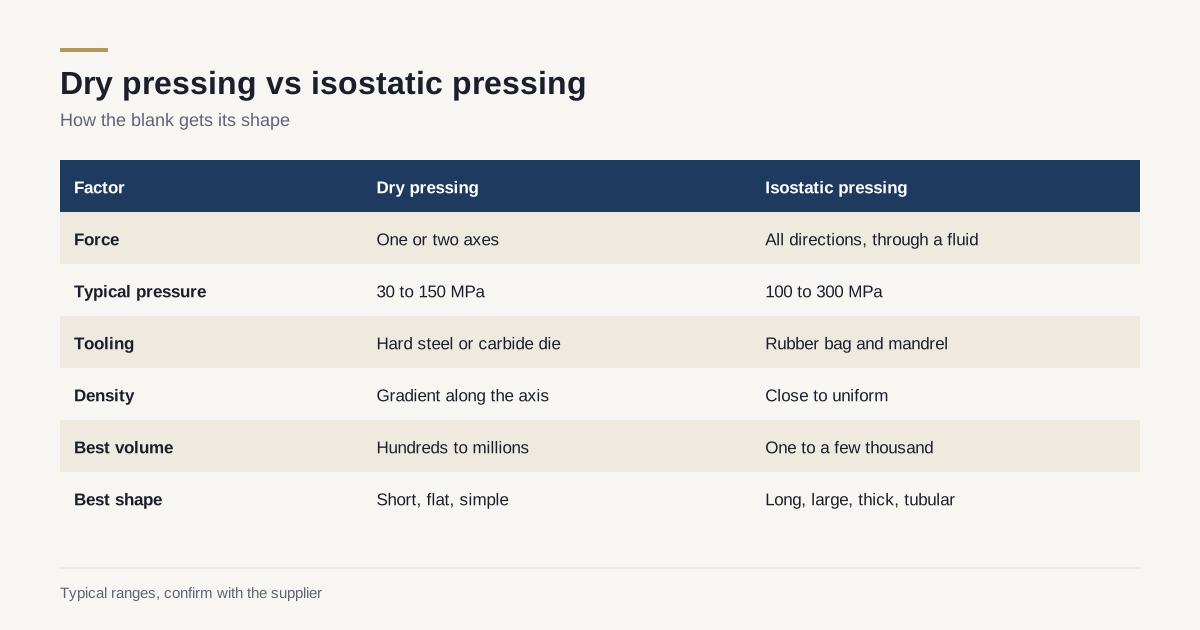
Before a ceramic part is ground to a drawing, it has to be formed from powder. The two most common ways to form a dense blank are dry pressing and isostatic pressing. Both squeeze granulated powder into a solid shape, and both give a “green” body that is fired afterwards. They differ in how the force arrives, and that decides what shapes are possible, what the tooling costs and how evenly the part shrinks.
How dry pressing works
Dry pressing, also called uniaxial pressing, fills a steel or carbide die with spray-dried powder granules that already contain a small amount of binder. A punch comes down from the top, sometimes another comes up from below, and the powder compacts in seconds. The part is ejected, handled gently and fired.
Strengths of the method:
- Speed. Automatic presses run many parts a minute on small shapes.
- Good near net shape. With a hard die the as-pressed dimensions repeat well from piece to piece.
- Low piece cost. Once the tooling exists the cost per part is small.
Weaknesses:
- Density gradients. Friction between powder and die wall means the powder near the punch compacts more than powder in the middle or at the far end. Those gradients show up as uneven shrinkage and sometimes as warp.
- Shape limits. Tall parts, undercuts and cross holes are difficult. As a working rule the fill depth stays short compared with the diameter, a few to one at most.
- Tooling cost. A hardened die with tight clearances is a real expense and is tied to one part shape.
How isostatic pressing works
In cold isostatic pressing, shortened to CIP, the powder is sealed inside a flexible mould, usually rubber or polyurethane. The mould goes into a vessel filled with fluid and the pressure rises, typically to somewhere between 100 and 300 MPa. The fluid pushes on every surface of the mould equally, so the powder compacts from all sides.
There are two versions:
- Wet bag. The filled and sealed mould sits directly in the fluid. It suits large, long and low volume parts.
- Dry bag. The flexible membrane is built into the vessel, so loading and unloading are faster. It suits tubes and rods made in repeat quantities.
Strengths:
- Uniform density. Without wall friction the density is much more even, so the part shrinks evenly in the kiln.
- Large and long shapes. Tubes, rods, crucibles and thick blanks that a die could never press.
- Cheaper tooling. A rubber bag and a steel mandrel cost far less than a hardened die.
Weaknesses:
- Poorer outer dimensions. The flexible mould does not control the outside geometry tightly, so the blank is pressed oversize and machined.
- Slower cycle. Each batch takes minutes to hours, not seconds.
- Extra work. Green machining or grinding is part of the normal route.
Side by side
| Factor | Dry pressing | Isostatic pressing |
|---|---|---|
| Force direction | One or two axes | All directions through a fluid |
| Typical pressure | About 30 to 150 MPa | About 100 to 300 MPa |
| Tooling | Hard steel or carbide die | Rubber bag and mandrel |
| Density uniformity | Gradients along the press axis | Close to uniform |
| Best volume | Hundreds to millions | One to a few thousand |
| Best shape | Short, flat, simple | Long, large, thick, tubular |
| Dimensional control | Good near net shape | Oversize, then machine |
The ranges are typical and vary by powder and press. They are a starting point for a discussion with the shop, not a specification.
Using both in one route
Many serious parts use both. A common sequence is to press a shape in a die at modest pressure, then CIP it to even out density before firing. The die gives the rough form cheaply and the isostatic step removes the gradients. Another common sequence is to CIP a long blank, green machine it close to the final shape and then fire it. The green machining step is covered in green machining vs hard machining ceramics.
What this means for shrinkage and tolerance
A ceramic part shrinks by roughly 15 to 25 percent in linear dimension when it fires. An uneven green density turns directly into uneven shrinkage, which is where warp and out-of-round tubes come from. That is why the forming route has an effect on the amount of grinding stock the shop must leave. For the full explanation of firing shrinkage, read sintering shrinkage explained.
Practical consequences for you:
- A dry pressed part can often be bought with a finer as-fired tolerance on key dimensions, if the volume justifies tooling.
- An isostatic blank will almost always be ground. Tolerances on the drawing will come from the grinder, not from the press.
- A long tube will warp less if it was isostatically pressed. Straightness tolerances in the drawing should reflect the route.
Grinding tolerances are covered in the tolerance and surface finish guide.
Typical faults by route
Each method has its own failure pattern, and knowing them helps you read a supplier’s scrap explanation.
Dry pressing
- Lamination. Trapped air or too much springback on ejection splits the part into thin layers. The crack often appears only after firing.
- Capping. The top of the part pops off in a disc. It comes from the same elastic recovery.
- Density banding. A visible change in shrinkage along the press axis, leaving a part that is slightly conical.
Isostatic pressing
- Elephant foot and bag marks. A flexible mould leaves a slightly irregular surface, which is why the blank is oversize.
- Wrinkles and folds. A badly fitted bag leaves creases in the surface that become flaws after firing.
- Dimensional drift. Bag wear changes the blank size gradually across a campaign, so the shop checks the blank before every machining run.
None of these is a reason to avoid either route. They are reasons to ask the shop how it inspects the blank and what the scrap rate has been on similar parts.
What the cost picture looks like
For a small flat part, say a 20 mm disc, the die costs a fixed amount once and then each piece costs very little. At 100 pieces the die dominates the price. At 100,000 pieces it is almost invisible. For a 60 mm diameter, 300 mm long tube, the same die would be huge and expensive, so isostatic pressing is the only practical choice at almost any volume.
Between those two cases sits a wide middle ground where the choice is not obvious, and where it makes sense to ask for two quotes. For help reading quotes side by side, see comparing ceramic quotes.
How to choose
Ask three questions in this order.
- How many parts per year? Under a few hundred, the cost of a hard die rarely pays back. Over a few thousand, it usually does.
- What is the shape? Long, thick or hollow shapes point to CIP. Short, flat shapes with simple profiles point to dry pressing.
- Where does the tolerance come from? If the drawing is tight on the as-fired surface, dry pressing with a dedicated die has the edge. If everything is ground anyway, the forming method matters less.
A fourth point is easy to overlook: the shop’s equipment. Most shops that grind ceramics do not press them. They buy blanks from a forming specialist and grind. So the question to ask is often “which blank supplier do you use and what route do they run”, not “do you press”.
Checklist for the RFQ
- Annual volume and batch size
- Whether the part must hold an as-fired dimension or can be ground all over
- Straightness or roundness limits on long parts
- Any requirement for density uniformity or property testing
- Whether you will accept a blank from a standard shape range instead of a custom press
For how the forming route fits the rest of the buying decision, see how to buy machined ceramic parts.
If you are unsure which route fits, describe the part and volumes in an RFQ and the matched shops will propose the route they run.
Frequently asked questions
Which pressing method is cheaper for a ceramic part?
Dry pressing wins at volume because each piece takes seconds once a hard die exists. Isostatic pressing wins at low volume and for long or large blanks because the tooling is a rubber mould and a mandrel, not a steel die. The crossover is often in the low thousands of pieces, but it depends on the part.
Does isostatic pressing give better properties than dry pressing?
It gives more uniform density through the blank, which means more even shrinkage and fewer distortion problems. Once both routes reach the same final density, the material properties are close. The difference is in consistency, not in the ceiling.
Can I machine a part pressed by either method?
Yes. Both give a green body that can be machined before firing, and both can be ground after firing. Isostatic blanks are more often green machined because they are pressed oversize, and dry pressed parts are more often used near net shape.
Need a quote for this part?
Send the drawing. We match you with up to 3 shops that grind this grade and reply within 24 business hours.
Get matched with a ceramic shop