Guides / Process
HIP for Ceramics: What the Extra Furnace Cycle Buys You
October 21, 2026
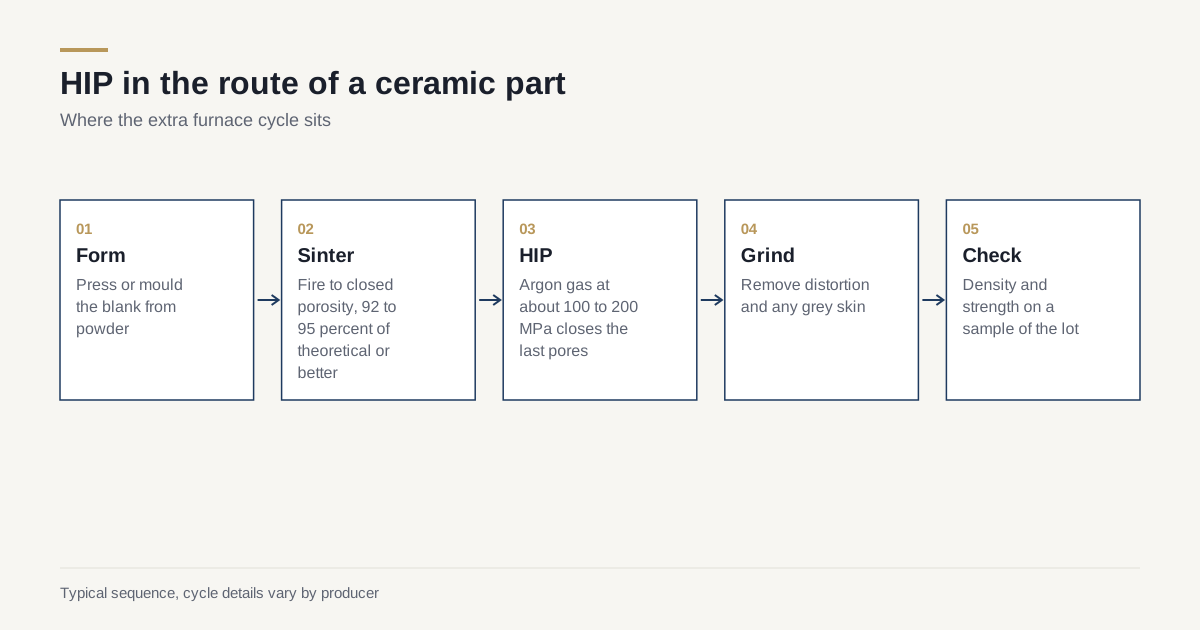
Hot isostatic pressing, shortened to HIP, puts a sintered ceramic in a pressure vessel, heats it and squeezes it from every side with hot inert gas, normally argon. The gas pressure closes the small pores that ordinary sintering leaves behind. The part comes out denser, a little stronger and much more consistent from one piece to the next.
It is a second thermal cycle on top of the first one, so it adds cost and lead time. This guide covers where it pays off, where it does not and how to write it into a request for quotation.
What actually happens inside the vessel
Ordinary sintering reaches a high density, often 96 to 99 percent of theoretical, but a few closed pores remain. Under load those pores act as starting points for cracks. The strength of a ceramic is set by its worst flaw, not by its average structure, so removing the largest pores raises the strength and, just as important, narrows the scatter.
In the HIP vessel the part sits at a temperature close to its sintering temperature while the gas pressure rises to somewhere around 100 to 200 MPa. The material deforms very slowly at that temperature and the pressure squeezes the closed pores shut. The gas cannot enter them because the part is sealed at the surface, which is why the part must already have closed porosity before it goes in.
There are two routes:
- Post-sinter HIP. The part is sintered to closed porosity first, then HIPed without any container. This is the normal route for oxide and nitride parts.
- Encapsulated HIP. Powder or a pre-pressed body is sealed inside a glass or metal can, then pressed. This route can reach full density without a separate sintering step but it costs more and leaves a can to remove.
Most buyers only ever meet the first route.
Typical conditions by material
| Material | Typical HIP temperature | Typical gas pressure | Main reason to HIP |
|---|---|---|---|
| Alumina | 1300 to 1500 degrees C | 100 to 200 MPa | Translucent grades, high strength grades |
| Y-TZP zirconia | 1300 to 1450 degrees C | 100 to 150 MPa | Medical and bearing parts, strength scatter |
| Silicon nitride | 1700 to 1800 degrees C | 100 to 200 MPa | Rolling elements, fatigue life |
| Sintered silicon carbide | 1800 to 2000 degrees C | 150 to 200 MPa | Seal faces, optical and armour parts |
These are typical ranges only. Each producer has its own cycle and the cycle is part of the material grade, so confirm it with the supplier rather than assuming it.
What you gain
Higher and tighter strength. The average flexural strength rises, but the larger gain is a higher Weibull modulus. In plain terms, fewer parts fail far below the average. For a part that is proof tested or that cannot be allowed to fail in service, that matters more than the average.
Better wear life. Pores at a sliding surface break out as pits and chip the counterface. A fully dense surface polishes to a cleaner finish. This is why bearing balls and seal faces are common HIP candidates. See silicon nitride balls and hybrid bearings for one example.
Optical quality. Alumina and some other oxides turn translucent when the last traces of porosity go. Those parts need HIP or a very careful vacuum sinter.
Cleaner polish. Lapping a dense body gives a lower roughness than the same body with scattered pores. The effect shows up directly in lapping, polishing and flatness work.
What it costs and what it can change
HIP vessels run in batches and each cycle takes many hours between heating, pressing and cooling. A shop either owns a vessel or sends parts to a service provider, which adds transport and queue time. As a rough planning figure, expect the step to add days to a couple of weeks to the schedule and a visible line to the price. Ask for it as a separate line item so you can judge it.
Other changes to watch for:
- Discolouration. Graphite heating elements create a reducing atmosphere. Oxide parts can come out grey or darker. A re-oxidation anneal in air usually restores the colour, though that is another step.
- Grain growth. Long hot cycles let grains grow slightly. In most grades the effect is small, but it can reduce hardness a little.
- Slight distortion. The part shrinks a little and may not shrink perfectly evenly. HIP before final grinding and leave grinding stock for it.
- Surface chemistry. Reaction between the part, the setter and the gas can leave a thin skin. Plan to grind it off on functional faces.
How a buyer can check that HIP happened
A part does not look different after HIP, so the evidence has to come from paperwork and measurement. Three checks work without special equipment:
- Density. An Archimedes density measurement on a sample from the lot, compared with the theoretical density of the grade, shows the result in a few minutes. A HIPed alumina or zirconia part sits very close to theoretical.
- Cycle record. Ask for the furnace log reference: peak temperature, peak pressure, hold time and the date. A shop that uses a service provider can pass this on.
- Test bars. If strength is the reason for HIP, ask for flexural bars from the same lot. Compare the average and, if the count allows, the scatter.
One practical point: density alone does not prove a good result. A part can be dense and still have a large flaw from forming. HIP closes pores but it does not repair a lamination crack that reaches the surface. If the cause of earlier failures was cracking from forming or machining, read why did my ceramic part crack before paying for another furnace cycle.
A worked example
Take a silicon nitride roller of 10 mm diameter that runs under contact load. The standard sintered grade gives acceptable life in most tests but a few rollers in each batch fail early from a subsurface pore. Moving to a HIPed grade removes most of those early failures. The roller costs more, yet the cost of a bearing failure in the field is many times the difference. That is the pattern where HIP makes sense: a small part, a high consequence and a flaw population that decides the outcome.
Now take a flat alumina spacer of 40 mm diameter that sits between two electrodes. The same extra cycle would change nothing the user could measure. Money spent there is money lost.
Where HIP is the wrong call
Skip it when:
- The part is a static insulator, a spacer or a fixture. Porosity there costs almost nothing.
- The part is made from a grade that already reaches full density by another route, such as a gas pressure sintered silicon nitride.
- The budget is tight and the failure mode is chipping at the edge, which HIP does not fix. Edge chipping is a grinding and design problem. See corner radius and edge chipping.
What to write on the RFQ
State the requirement as a result, not only as a process. A line such as “density at least 99.5 percent of theoretical, supplier to state whether HIP is used” lets the shop pick a route. If you need a specific cycle because a qualification depends on it, say so and ask for the cycle record with the shipment.
Useful items to include:
- Required density or strength figure, with the test method you will accept.
- Whether translucency or colour matters.
- Where HIP sits in the sequence: before finish grinding.
- Whether you need a certificate of conformance for the HIP lot.
- Any limit on grey discolouration.
The wider list of items that belong on a request is in the ceramic RFQ checklist.
Before you pay for it
- Name the failure you are trying to prevent. If you cannot, you probably do not need HIP.
- Ask whether the standard grade already includes it. Many bearing and medical grades do.
- Ask for the density result, not only a statement that the lot was HIPed.
- Confirm the grinding allowance after HIP.
- Compare a HIPed quote with a quote for a different grade, since a stronger base grade can be cheaper than a weaker one plus HIP.
If you want shops that grind HIPed material to your drawing, send the drawing through the RFQ page and state the density requirement.
Frequently asked questions
Does HIP change the dimensions of a ceramic part?
Only slightly. A part that goes into HIP is already at closed porosity, so the further shrinkage is small, usually a few tenths of a percent. Plan the HIP step before final grinding so the grinder removes any distortion and any surface discolouration.
Can any sintered ceramic be HIPed?
A part can go in without a can only if its pores are closed to the surface, which usually means 92 to 95 percent of theoretical density or better. Below that the gas enters the pores and nothing closes. Lower density parts need a glass or metal can, which is a different and more expensive route.
Is HIP worth it for an alumina insulator?
Usually not. An insulator that sees low mechanical stress gains little from removing a few percent of porosity. HIP earns its cost on parts where strength scatter, wear or optical quality decides the job.
Need a quote for this part?
Send the drawing. We match you with up to 3 shops that grind this grade and reply within 24 business hours.
Get matched with a ceramic shop