Guides / Applications
Silicon Nitride Balls in Hybrid Bearings: Speed, Insulation and Limits
October 26, 2026
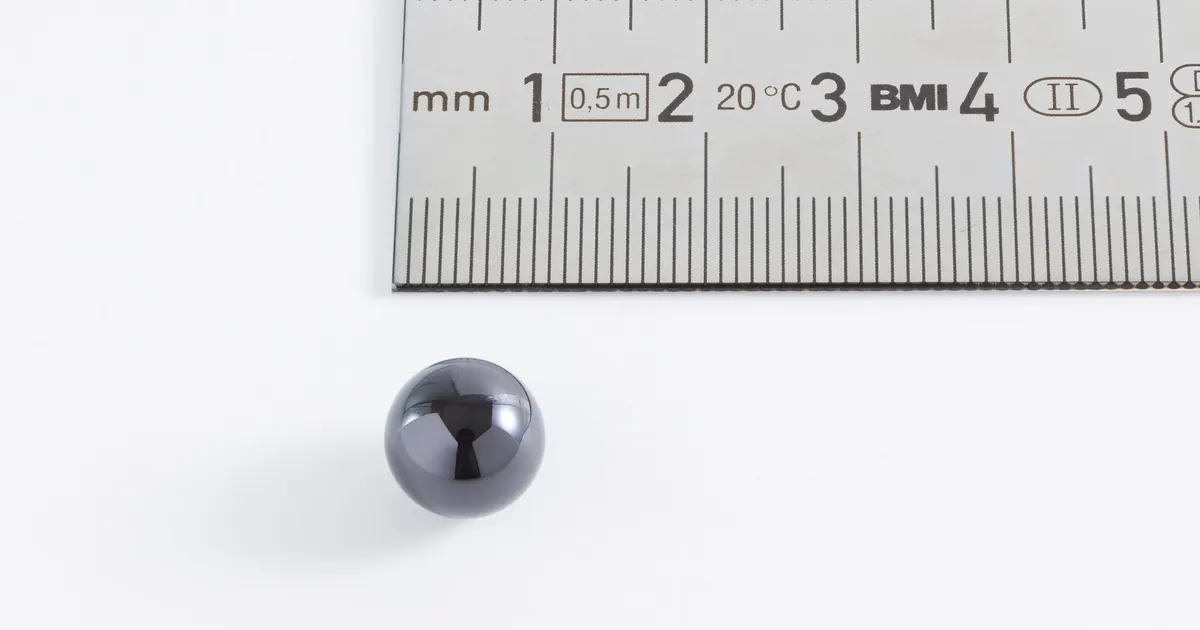
Bearings are the hidden workhorses of machines, and the balls inside them are among the most carefully made parts of any product. For decades the ball was bearing steel. Silicon nitride changed that in demanding applications, and today it is the standard ceramic ball in hybrid bearings, which pair ceramic balls with steel rings.
This guide explains why, how to read a ball specification and where silicon nitride is not the right answer.
Why silicon nitride suits balls
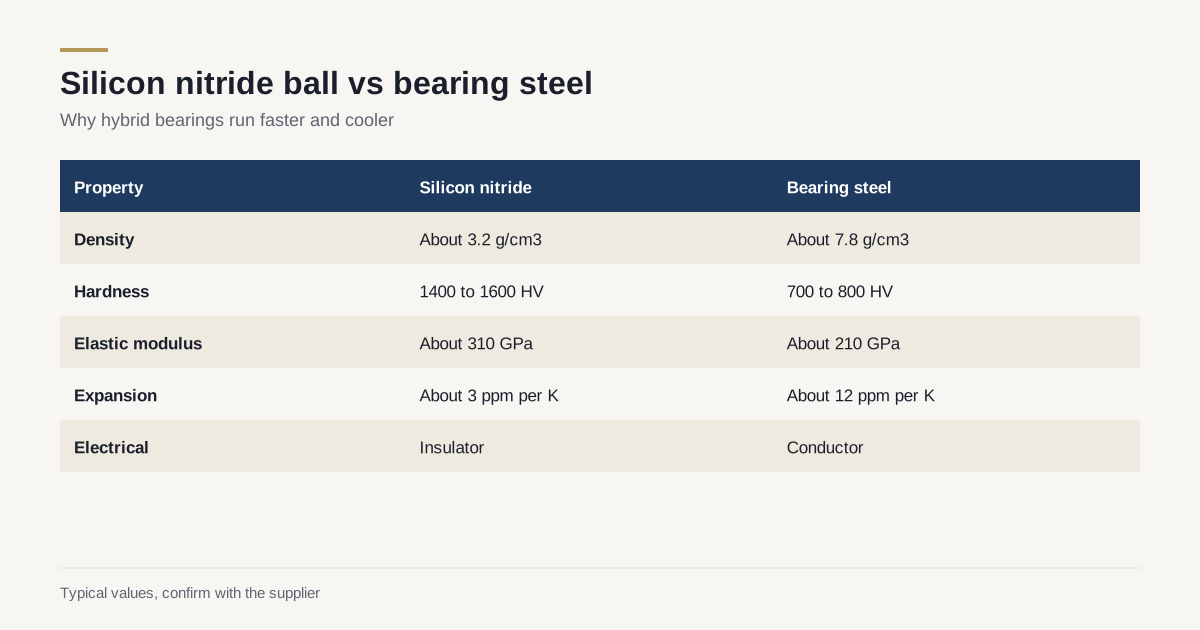
Compared with bearing steel, silicon nitride is:
- Lighter. About 3.2 g/cm3 against about 7.8 for steel, roughly 60 percent less. Lower mass means less centrifugal force on the outer ring at high speed.
- Harder. Typical hardness is around 1500 HV against 700 to 800 for steel. It resists wear and surface damage.
- Stiffer. Elastic modulus is about 310 GPa against about 210 for steel, which helps preload stiffness in spindles.
- Lower in thermal expansion. About 3 ppm per K against about 12 for steel, so size changes less with temperature.
- An electrical insulator. It blocks current through the bearing, preventing the electrical erosion that damages bearings in variable-speed motors.
- Non-magnetic and corrosion resistant.
- Low in friction and compatible with marginal lubrication. It resists the cold welding that can occur when steel contacts steel through a broken oil film.
Silicon nitride is the preferred ceramic among oxides, carbides and other nitrides because it combines strength, toughness and fatigue resistance. Alumina and zirconia balls are used in corrosion duty, but they lack its rolling contact fatigue life. See silicon carbide vs silicon nitride for the comparison with SiC.
Typical properties
| Property | Silicon nitride bearing grade | Bearing steel (52100) |
|---|---|---|
| Density | About 3.2 g/cm3 | About 7.8 g/cm3 |
| Hardness | About 1400 to 1600 HV | About 700 to 800 HV |
| Elastic modulus | About 310 GPa | About 210 GPa |
| Thermal expansion | About 3 ppm per K | About 12 ppm per K |
| Fracture toughness | About 6 to 7 MPa m^0.5 | Much higher, ductile |
| Electrical behaviour | Insulator | Conductor |
| Maximum use temperature | Above 800 degrees C | About 150 to 200 degrees C |
Figures are typical. A bearing ball specification refers to a standard, such as ASTM F2094 for silicon nitride bearing balls, and to the ISO 3290 ball grade system. Check which standard applies to your order.
Ball grades
A ball grade is a set of tolerances on shape and size. Smaller numbers mean tighter tolerance.
| Grade | Typical sphericity limit | Common use |
|---|---|---|
| G3 | About 0.08 micrometre | Highest precision spindles, instruments |
| G5 | About 0.13 micrometre | Precision spindles, dental, aerospace |
| G10 | About 0.25 micrometre | Industrial and motor bearings |
| G16 | About 0.4 micrometre | General industrial |
| G28 | About 0.7 micrometre | Low speed and non-critical |
The sphericity and diameter variation within a lot are what the bearing maker pays for, because a lot with tight variation shares the load evenly across all balls. Confirm limits against the current standard.
How the balls are made
The powder is mixed with sintering aids and pressed or isostatically pressed into a blank. The blank is sintered and then hot isostatic pressed, to remove the last porosity. Then the blanks are rough ground, finish ground and finally lapped to size with progressively finer diamond until the ball reaches its grade.
HIP matters because a single subsurface pore can start a rolling contact fatigue spall. See hot isostatic pressing for ceramics. Lapping is a slow, controlled process and takes the larger part of the cost. See lapping, polishing and flatness for how fine finishing works.
Where hybrid bearings earn their cost
- Machine tool spindles. High speed, low heat and stiffness help accuracy and life.
- Electric motors and drives. Electrical insulation blocks stray current that pits steel balls and races, a known cause of bearing failure in inverter-driven motors.
- Vacuum and dry running. Ceramic balls tolerate poor lubrication better than steel.
- Chemical and corrosive duty. Full ceramic bearings with ceramic rings handle fluids that attack steel.
- Medical and dental tools. High speed handpieces and sterilisable devices.
- Bicycles and precision gear. Some premium parts offer lower friction.
For the broader decision between ceramic and metal wear parts, see ceramic, carbide or hardened steel for wear parts.
Where they do not
- Low-speed, heavy load. Steel balls can handle shock loads that would chip a ceramic ball, and the extra cost brings nothing.
- Impact and misalignment. Hard, brittle balls fail suddenly when shock-loaded.
- Commodity bearings. Where the steel bearing already outlives the machine, ceramic balls only add cost.
- High contact stress on steel rings. The ceramic’s stiffness raises contact stress on the steel race, which needs a design check by the bearing maker.
Temperature and lubrication notes
The bearing’s rings and cage still limit the temperature of a hybrid bearing. Steel rings are normally heat treated for use up to about 150 to 200 degrees C, and polymer cages and greases set lower limits. A silicon nitride ball can run far hotter, but the bearing as a whole cannot, unless the maker uses high-temperature steel or ceramic rings. Do not read the ball’s temperature rating as the bearing’s.
Lubrication also needs attention. Silicon nitride runs well with a thin film, so many hybrid bearings run with less grease than steel ones, and the lower friction means the grease lasts longer. Too much grease raises churning loss and heat at high speed, which cancels part of the benefit.
Inspection a buyer can expect
Ball lots come with data, and it is worth knowing what the figures mean.
- Diameter variation within a lot. The difference between the largest and smallest ball. A small value means the load is shared evenly.
- Sphericity. The largest deviation from a perfect sphere on any ball, measured with a roundness or sphericity instrument.
- Surface roughness. An average roughness figure, usually in tens of nanometres for precision grades.
- Surface flaw inspection. Many makers inspect surfaces visually under magnification or by eddy current or optical scanning, and reject balls with cracks or pits above a limit set in the standard.
- Material records. Lot number, density and, for qualified material, HIP and chemistry records.
For general practice on measurement reports, read how ceramic parts are inspected.
A worked example
A manufacturer builds a motor-driven spindle that runs at high speed with an inverter. The steel bearings last a few months and then fail with fluted raceways, the pattern left by stray electrical current. Swapping to hybrid bearings with G10 silicon nitride balls stops the current path, because the balls are an insulator, and the flutes disappear. The bearings also run a few degrees cooler. The cost per bearing is several times higher than steel, but the failure rate drops, so the spindle’s service interval stretches from months to years.
In a different machine, a slow conveyor roller carries a heavy load and runs with grease. Hybrid bearings there would bring little. The steel bearing already lasts for years. Cost goes up and the benefit does not. The bearings should match the failure the machine actually suffers, not the failure it might have in theory.
What goes wrong
- Spalling from subsurface flaws. A pore or inclusion near the surface can flake a piece out. Quality HIP material cuts this risk.
- Surface damage from contamination. Hard particles in the lubricant dent the balls and rings.
- Wrong preload. Because ceramic balls are stiffer and have different expansion, preload set for steel can be wrong at temperature.
- Race damage. A steel race with a lower hardness than the ball can wear faster than a steel-steel pair under poor lubrication.
Checklist for the RFQ
- Ball diameter and tolerance, with the standard.
- Ball grade.
- Material specification, including HIP and density.
- Lot size and the maximum variation within a lot.
- Surface roughness requirement.
- Inspection and traceability records.
- Packaging, since balls are dispatched in sealed lots.
- Quantity and delivery schedule.
To find shops and ball makers that supply to your specification, describe the duty and the dimensions in an RFQ.
Frequently asked questions
What is a hybrid bearing?
A hybrid bearing uses steel rings with silicon nitride balls. It keeps the familiar ring and cage design while the ceramic balls bring lower weight, higher stiffness, electrical insulation and lower friction. A full ceramic bearing has ceramic rings too.
Do silicon nitride balls last longer than steel balls?
In many conditions, yes. They resist wear, run with less heat and tolerate marginal lubrication better than steel. Actual life depends on load, speed, lubrication and mounting, so treat any life multiple from a catalogue as indicative.
What ball grade should I choose?
Grade is a measure of sphericity, size variation and surface finish. Precision spindles often use G5 or G3, general industrial bearings G10 to G16 and low speed or commodity uses G28. The bearing maker usually sets it.
Need a quote for this part?
Send the drawing. We match you with up to 3 shops that grind this grade and reply within 24 business hours.
Get matched with a ceramic shop