Guides / Applications
Ceramic Wire Guides, Yarn Guides and Textile Wear Parts: What to Specify
October 16, 2026
A thread moves over a guide a few hundred metres every minute, hour after hour, for months. Over that run, a hard guide keeps its shape and a soft one cuts a groove that wears the thread. The same logic applies to wire in a winding or drawing line: a guide that wears changes the path, scores the wire and adds scrap.
That is why ceramic guides and pulleys are common in the textile and wire industries. This guide sets out what they are made from, which features matter on the drawing and how failures arise.
What the part has to do
- Guide the yarn or wire without abrading it. The surface that touches the material must be smooth and free of burrs.
- Resist abrasion. The load per metre is small, but the number of metres is very large.
- Hold shape over millions of metres. Wear creates a groove that fixes the thread path and damages it.
- Cost little per piece. Guides are numerous and replaced regularly, so unit cost matters.
- Handle heat and static. Fast thread generates frictional heat and, with synthetic fibre, static charge.
Typical parts in the family
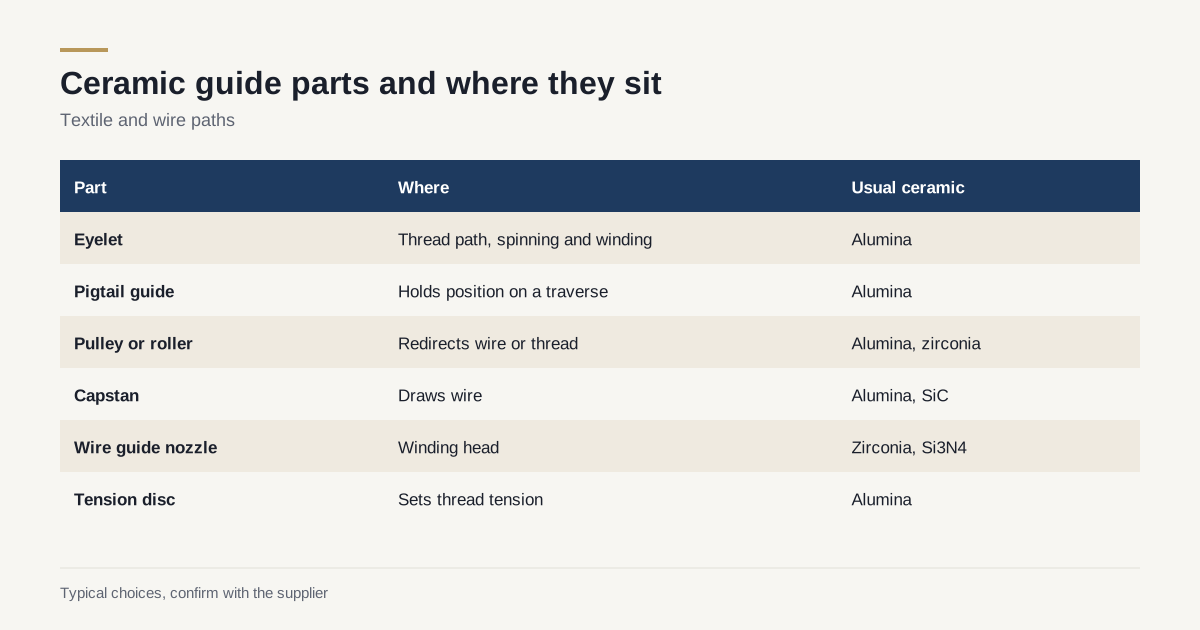
| Part | Where it sits | Typical material |
|---|---|---|
| Eyelet or ring guide | Thread path on spinning and winding machines | Alumina |
| Pigtail guide | Holds thread position on a traverse | Alumina, metal pigtail with ceramic insert |
| Traverse guide | Moves thread across a package | Alumina or zirconia |
| Rod or pin guide | Fixed bar that turns the thread path | Alumina |
| Pulley and roller | Redirects wire or thread | Alumina or zirconia |
| Capstan | Drives or draws wire | Alumina or silicon carbide |
| Wire guide nozzle | Guides wire into a winding head | Alumina, zirconia or silicon nitride |
| Tension disc | Pinches thread to set tension | Alumina |
The shapes are simple: rings, rods, discs, grooved wheels and tubes. That suits dry pressing and tumble polishing, which makes millions of pieces cheaply. See dry pressing vs isostatic pressing for the forming methods.
Choosing the ceramic
| Material | Strengths | Limits |
|---|---|---|
| Alumina, 96 to 99.7 percent | Hard, low cost, well proven | Brittle, can chip on knocks |
| Zirconia | Tough, tolerates impact and fine edges | Higher cost, lower hardness than alumina |
| Silicon carbide | Very hard, conducts heat | Cost, brittle |
| Silicon nitride | Tough and wear resistant | Cost |
| Titanium oxide based ceramics | Used in some yarn guides for specific finish and friction properties | Lower hardness than alumina |
For most textile guides alumina is the answer, because the cost per piece is very low and the hardness is ample. Zirconia suits thin or sharp features, like the edge of an eyelet or a thin wire guide nozzle, where chipping is a concern. Silicon carbide and nitride suit glass fibre, carbon fibre and metal wire, which are extremely abrasive. For the broader comparison, see ceramic, carbide or hardened steel for wear parts and alumina vs zirconia: which to specify.
Surface finish: not always the smoothest
A guide’s finish has to balance two things.
- Too rough. The surface abrades the thread and creates fuzz or breaks.
- Too smooth. A mirror surface can raise friction in some fibres or cause stick-slip, where the thread grabs and releases and the tension jumps.
The right roughness depends on the fibre, the speed and the tension. Many guides use a controlled fine finish, in the range of Ra 0.1 to 0.4 micrometre, and some use a deliberately matt texture to manage friction. State the roughness on the drawing as a range with the measurement method, and ask the user or the yarn maker which finish works in the line. For how finish is measured and written, see the tolerance and surface finish guide.
Shape details that matter
- Edge radius at the entry and exit. A sharp edge cuts the thread. A generous, uniform radius protects it.
- Eye or bore shape. A smooth, round, burr-free eye. Any flat spot or chip starts a thread snag.
- Polish of the bore. The inside of an eyelet gets the most contact and needs the most care.
- Concentricity. On a ring guide or pulley the groove should run true.
- Groove profile. Pulleys have a V or U groove, sized to the thread or wire diameter.
- Mounting features. Press fits, shoulders or threads for the holder. These carry more stress than the working surface.
See corner radius and edge chipping for guidance on radii in ceramic parts.
How these parts are finished
Guides are made in huge numbers, so the finishing route is built for volume.
- Pressing and firing. The shape is pressed and fired near its final size. Fired surfaces are fairly rough and carry small defects.
- Tumbling. Parts are tumbled in a drum with media and abrasive for hours, which rounds the edges and polishes the surface. This is the standard route for textile eyelets, and it gives the controlled finish.
- Bore finishing. Where the eye must be especially smooth, a finishing step with a diamond-charged wire or abrasive slurry is used.
- Inspection. A sample of each lot is checked under magnification for chips and under a profile gauge for the radius. Some makers run a thread test with a standard yarn to check for snags.
The tumbled finish has a particular character: it is smooth but not mirror-like, with soft rounded edges. Many mills prefer that over a ground and polished finish because it grips the yarn predictably. If you change the finishing route, test the new guides on the machine before a full changeover.
A worked example
A mill spinning polyester filament yarn changes to a bright, fine yarn with a heavy delustrant load. The steel eyelets begin to groove after a few weeks, and the yarn shows fuzz and breaks. The mill moves to 99.5 percent alumina eyelets with a tumbled finish. Grooving stops and the changeover interval stretches from weeks to many months. After a while a few eyelets chip at the edge from knocks during threading, and the mill sees breaks again at those positions. Inspecting the guides on a regular round, and replacing a chipped one on sight, keeps the yarn clean. The ceramic solved the wear problem and created a new one: chips from impact. A guide change fixes one failure mode and can leave another. The inspection routine matters as much as the material.
What goes wrong
- Grooving. The thread cuts a track into the guide, especially with abrasive synthetic yarn or glass fibre.
- Chipping at the edge. A knock during threading or mounting leaves a chip that then cuts the yarn.
- Static buildup. Ceramic is an electrical insulator, and synthetic yarn can charge on it, which affects handling. Ask about the supplier’s options for this.
- Cracking from heat. Hot wire or a hot spot may cause cracking if the part is rapidly cooled. See ceramic thermal shock testing.
- Loose fit. A guide that works free in its holder vibrates and wears the holder.
Checklist for the RFQ
- Yarn or wire type, diameter, speed and tension.
- Abrasive content, such as delustrant, glass or carbon fibre.
- Ceramic material, or the duty so the shop can propose one.
- Drawing with edge radii, bore shape and roughness range.
- Mounting details, including fit tolerance.
- Annual quantity, since these parts run in large volumes.
- Whether you need a polished, matt or tumbled finish.
- Sampling and inspection requirements for finish and chips.
To compare shops that make wear guides, send the drawing, the duty and the quantities through the RFQ page.
Frequently asked questions
Why are ceramic guides used on textile machines?
Yarn runs over a guide at high speed for thousands of hours. Synthetic yarn often carries abrasive delustrant particles that cut a groove in steel, which then cuts or fuzzes the yarn. A hard ceramic keeps its smooth profile for much longer, so the yarn quality stays stable.
Should a yarn guide be as smooth as possible?
Not always. A mirror finish can let yarn slip or stick-slip depending on the fibre. Many guides use a defined fine finish, and the best roughness depends on the yarn and the tension. The specification should state the roughness range, not only the word polished.
Which ceramic is used for wire guides?
Alumina at 99 percent or better is the standard. Zirconia is chosen where toughness matters, and silicon carbide or silicon nitride for the most abrasive wire and fibre. The right grade depends on the wire material and speed.
Need a quote for this part?
Send the drawing. We match you with up to 3 shops that grind this grade and reply within 24 business hours.
Get matched with a ceramic shop