Guides / Process
Glazing and Sealing: Making a Porous Ceramic Part Hold Up in Service
October 20, 2026
Not every technical ceramic is dense. Fully sintered alumina at 99 percent purity or sintered silicon carbide has essentially no open porosity, so a liquid or a gas cannot pass through the wall. Many other ceramics do. Cordierite and mullite grades, steatite, low purity alumina bodies and some refractory ceramics keep a network of small pores that reach the surface. For a kiln support that does not matter. For an insulator in a damp environment, a vessel that holds liquid or a part that has to stay clean, it does.
Glazing and sealing close those pores. They are cheap compared with changing the material, but each has limits that buyers often discover late.
Why open porosity causes trouble
Open pores do four things:
- Absorb moisture. Water in the pores lowers the surface resistance of an insulator and gives leakage paths, especially in high humidity.
- Trap contamination. Oils, process residues and particles stay in the pores and release later, which is a concern in vacuum and cleanroom use.
- Leak. Gas or liquid can pass through a thin wall.
- Hold abrasive grit. A pore filled with grit wears a mating part.
A simple water absorption test shows how open a body is. A dense technical ceramic absorbs close to nothing. A porous body can take on several percent of its weight in water.
The main ways to close the surface
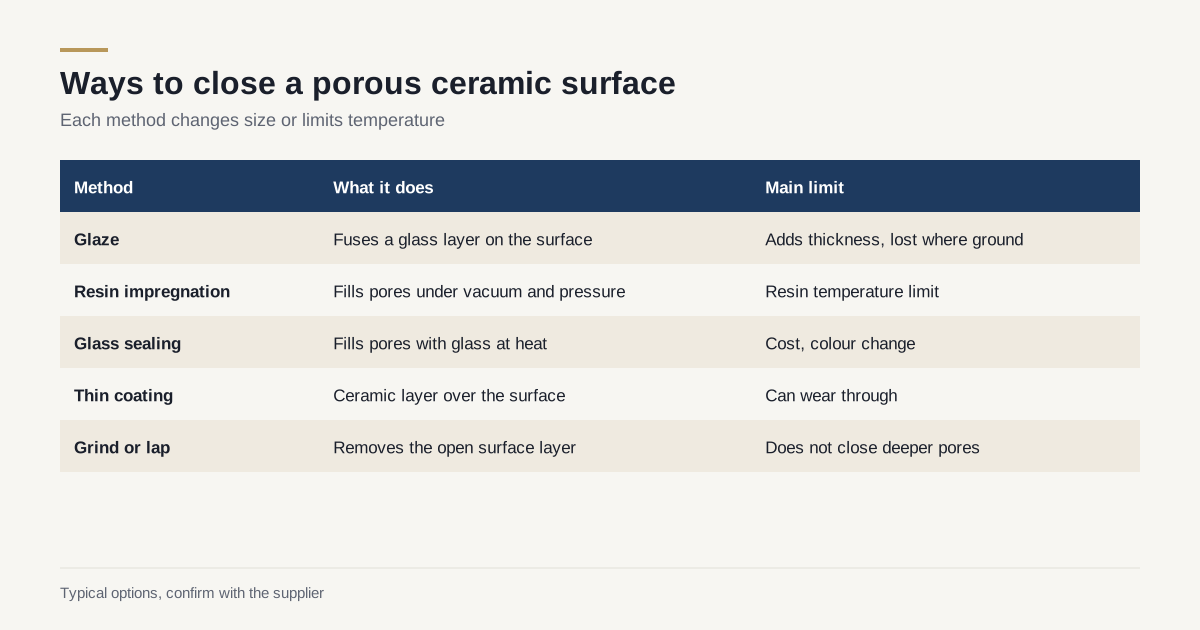
| Method | What it does | Typical use | Main limit |
|---|---|---|---|
| Glaze | Fuses a glass layer onto the surface | Electrical insulators, housings | Adds thickness, ground faces lose it |
| Resin impregnation | Fills pores with polymer under vacuum and pressure | Low temperature seals, pressure parts | Temperature limit of the resin |
| Glass or silicate sealing | Fills pores with glass at high temperature | Higher temperature seals | Process cost, colour change |
| Sol-gel or vapour coating | Thin ceramic layer over the surface | Special purpose | Thin, can wear through |
| Grinding or lapping | Removes the open surface layer | Sliding or sealing faces | Does not close pores below the surface |
Glazing in more detail
A glaze is a fine powder of glass forming material, applied as a slurry or spray, then fired. It melts to a thin, dense layer that bonds to the ceramic.
What a good glaze gives you:
- A smooth, non-porous, easy to clean surface.
- Higher electrical surface resistance in damp air.
- A higher bending strength in some bodies. The glaze is chosen to shrink slightly less than the body on cooling, so it ends up in compression. That compressive skin hides small surface flaws.
What to watch:
- Thermal expansion match. If the glaze shrinks more than the body, it ends up in tension and forms a fine network of cracks called crazing. If it shrinks too little, it can shell off at edges. The glaze must be matched to the body.
- Thickness. A typical glaze layer is on the order of a tenth to a few tenths of a millimetre. That changes dimensions, and the thickness is not perfectly even. Pooling in corners and thinning on edges are normal.
- Firing temperature. The glaze is fired at a lower temperature than the body, but still high enough to affect some special bodies. Check that a second firing does not harm the material.
- Colour and gloss. The glaze may be white, coloured or clear. Colour should be agreed before the order.
Glazing and machining do not mix well
A ground face has no glaze on it. That is not a defect, it is a consequence of the process. If a part needs both tight dimensions and a sealed surface, there are three practical sequences:
- Machine first, then glaze. Works when the glaze thickness can be included in the tolerance. Leave areas that must stay bare, like contact faces, masked during glazing.
- Glaze first, then grind only the faces that need accuracy. Those faces are unglazed, and a small unglazed zone is acceptable when its location is chosen with care.
- Seal after grinding with impregnation. Works for pressure and vacuum parts where a glassy surface is not required.
For the grinding step itself, see how diamond grinding works, and for the tolerances you can hold on ground faces see the tolerance and surface finish guide.
Impregnation and glass sealing
Vacuum-pressure impregnation removes air from the pores, then forces resin or another sealant in. After curing, the surface is sealed to depth. It is common on cast and sintered porous parts in other industries and is available for technical ceramics too. The big limit is temperature: most resins soften or degrade well below the temperature a ceramic can take.
Glass sealing works like a localised glaze that reaches into the pores. It handles higher temperatures but costs more and can change colour or dimension.
If your part runs hot, check the sealant’s limit as carefully as the ceramic’s own limit.
How to test whether a seal works
A glaze that looks good can still carry pinholes. Three simple checks catch most of them:
- Dye test. Brush or dip the part in a coloured penetrant, wipe and look for traces of dye in the surface. A pinhole shows up as a point of colour. The same principle is used for crack finding, see detecting cracks in ceramics.
- Water absorption. Weigh the dry part, soak it for a set time, wipe it and weigh again. A sealed body gains almost nothing.
- Insulation resistance in humidity. For electrical parts, measure resistance after exposure to damp air and compare it with the dry figure. A properly glazed insulator keeps most of its resistance.
For vacuum or pressure parts, a leak test with helium or a pressure decay test is the right check. State the leak rate you need and the method, because a part that passes a dye test may still leak through a few connected pores.
Common mistakes buyers make
- Specifying a glaze on a precision face. The glaze thickness varies and cannot hold a tight flatness. Seal faces and datum faces should be ground or lapped and left bare.
- Forgetting the second firing. A glazed part has seen another heat cycle. If a special body, a metallised layer or a brazed joint is already in place, the glaze firing can damage it. Sequence the operations carefully.
- Assuming a glaze fixes a poor body. A glaze covers pores at the surface, but a wall full of connected porosity can still pass fluid through a chip or a ground edge.
- Skipping the expansion data. A change of body, even to a similar grade from another producer, can need a different glaze.
When the answer is a denser material
Sealing is a patch. If the application needs vacuum tightness, clean surfaces or resistance to aggressive fluids, it is often simpler to specify a dense grade from the start. Alumina at 99 percent or better, and sintered silicon carbide, give a body with no open porosity and no second process. For thermal cycling grades, where porosity helps, see cordierite vs mullite for thermal cycling.
Checklist for the drawing and the RFQ
- State the open porosity or water absorption limit, with the test method.
- Say which faces must be glazed, which must stay bare and which must be ground.
- Give the permitted glaze thickness or the tolerance after glazing.
- State the maximum service temperature, since it limits the choice of sealant.
- Name the colour if appearance matters.
- Ask the shop to confirm that the glaze is matched to the body.
To find shops that handle glazed or impregnated parts, describe the application in an RFQ and state which sealing route you prefer.
Frequently asked questions
Is a glaze the same as a coating?
A glaze is a thin layer of glass fused onto the ceramic at high temperature. It bonds chemically with the surface and becomes part of the part. A coating is a broader term and includes sprayed, painted or vapour deposited layers that sit on the surface without fusing into it.
Can I grind a glazed ceramic part?
You can, but grinding removes the glaze where it touches. Glaze the part after machining, or accept that ground faces are unglazed and plan the sealing of those faces separately.
Do dense ceramics like alumina need sealing?
Fully dense grades such as 99 percent alumina and sintered silicon carbide have no open porosity, so they do not need it. Lower density bodies, steatite, cordierite and mullite grades may.
Need a quote for this part?
Send the drawing. We match you with up to 3 shops that grind this grade and reply within 24 business hours.
Get matched with a ceramic shop