Guides / Materials
Cordierite or Mullite: Picking a Refractory Ceramic for Repeated Heating
October 17, 2026
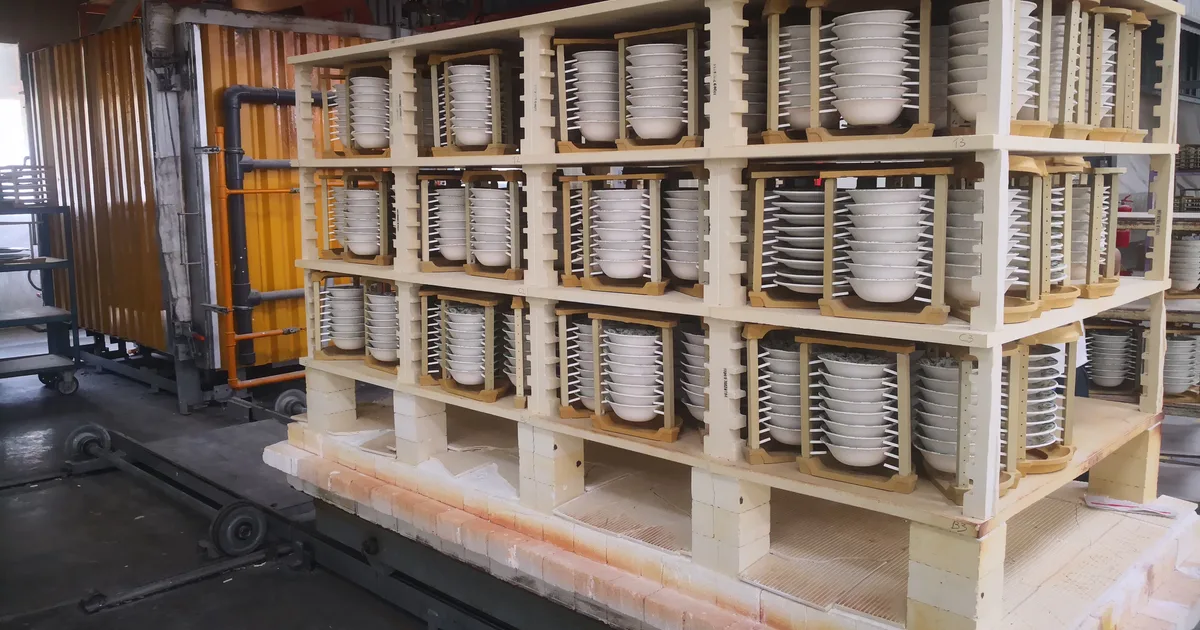
Some jobs put a ceramic through hundreds of heating and cooling cycles a year. Kiln shelves go from room temperature to a firing peak and back. Burner parts see a flame lit and put out. Heater supports follow the on-off rhythm of a process. For these jobs, the right material is rarely the hardest or the strongest. It is the one that survives the temperature swing.
Cordierite and mullite are the two oxide refractory ceramics that cover most of this ground. They look alike, but they trade strength, temperature and shock resistance in different ways.
What the two materials are
Cordierite is a magnesium aluminium silicate, 2MgO·2Al2O3·5SiO2. Its crystal structure expands very little when heated, so the body has a very low thermal expansion coefficient. It is a common material for kiln furniture, burner parts, heat exchanger cores and catalytic converter honeycombs.
Mullite is an aluminium silicate, 3Al2O3·2SiO2. It is a stable phase with good creep resistance and keeps its strength at high temperature. It appears in kiln furniture, furnace tubes, thermocouple protection tubes and refractory linings. Dense mullite for technical use is more costly than the common refractory grades.
Typical properties
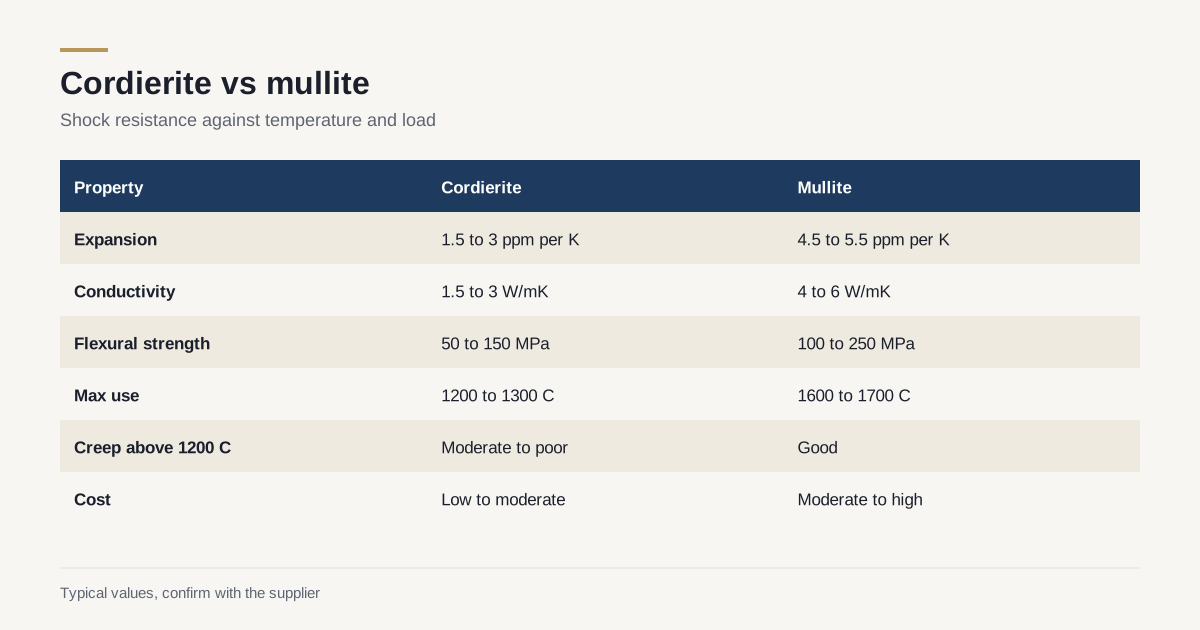
| Property | Cordierite | Mullite |
|---|---|---|
| Thermal expansion | About 1.5 to 3 ppm per K | About 4.5 to 5.5 ppm per K |
| Thermal conductivity | About 1.5 to 3 W/mK | About 4 to 6 W/mK |
| Flexural strength | About 50 to 150 MPa | About 100 to 250 MPa for dense grades |
| Maximum use temperature | About 1200 to 1300 degrees C | About 1600 to 1700 degrees C |
| Porosity | From a few percent to about 30 percent | Dense or porous grades |
| Creep resistance | Moderate to poor above 1200 | Good |
| Cost | Low to moderate | Moderate to high |
Figures are typical ranges for commercial grades. Porous grades sit at the low strength end. Always use the datasheet of the grade and the supplier.
Why expansion matters most for cycling
Thermal stress is roughly proportional to the expansion coefficient times the temperature difference across the part, times the elastic modulus. Cut the coefficient in half and the stress for the same gradient halves too. That is the whole reason cordierite shrugs off cycling. Its expansion is around a third to a half of mullite’s, so for the same temperature gradient, the stress is much lower.
Low thermal conductivity makes the gradients larger, which partly cancels the benefit. Cordierite has less conductivity than mullite, and thin sections help. A cordierite plate of 8 mm will outlast one of 25 mm in repeated heating and cooling for just this reason.
For the underlying mechanisms and the test methods, see thermal shock testing of ceramic parts.
Where cordierite wins
- Rapid cycles below about 1250 degrees C. Burner nozzles, pizza oven bricks and stones, gas appliance parts and kiln furniture in fast firing.
- Large flat parts. The low expansion keeps shelves and plates from warping or cracking from edge to centre gradients.
- Cost sensitive production. Extruded and pressed shapes are inexpensive.
- Honeycomb and filter structures. The same property is why catalytic converter substrates are made from it.
Where mullite wins
- Temperatures above about 1300 degrees C. Cordierite starts to soften, mullite holds.
- Loaded parts at heat. Setters that carry weight at peak temperature creep less in mullite.
- Chemically harsh hot zones. Mullite resists many slags and vapours better than cordierite.
- Tubes for gas-tight service. Dense mullite tubes are used for thermocouple protection and furnace work. See ceramic thermocouple tubes and heater parts.
Hybrid grades and the grey area
Producers also make cordierite-mullite composites, which aim at an in-between balance: better shock resistance than plain mullite and better temperature capability than plain cordierite. These are common in kiln furniture where setters are loaded and also cycled. If neither pure grade fits, ask a shop about a composite, and ask for the datasheet figures at your operating temperature.
When neither is right
- Above about 1700 degrees C. Look to alumina or zirconia grades, or to non-oxide options.
- Where heat must flow out. Both are poor conductors. Aluminium nitride or silicon carbide work better. See aluminium nitride vs alumina for heat paths.
- High strength under load at room temperature. Alumina or zirconia carry load better.
- Very clean environments. Porous refractory bodies shed dust and absorb contaminants.
Silicon carbide and silicon nitride are the next step up for shock and heat together, at a higher price. See silicon carbide vs silicon nitride.
How each one fails
Knowing the failure mode helps you read a service history.
Cordierite
- Slow sag. Above its comfortable range, a loaded shelf creeps and bows in the middle. The shelf does not break. It bends until it touches the load.
- Glaze build-up and attack. Fluxes and vapours from the ware react with the surface and weaken the first millimetre.
- Spalling at edges. Thermal cycling over a long period peels flakes from corners.
- Porous grades absorb. Liquids and fluxes soak into pores and, on heating, expand and flake the surface.
Mullite
- Cracks from fast cooling. A sharp quench on a thick part can crack it, since the expansion is higher.
- Slag attack at the melt line. In contact with aggressive melts, a dense mullite part loses material at the line where the melt meets the air.
- Brittle fracture from impact. Like any dense ceramic, it breaks suddenly if dropped or struck.
A worked example
A pottery fires on a 14 hour cycle to 1250 degrees C. The kiln furniture is 10 mm thick cordierite shelves resting on posts. After a year, the shelves show a slight bow and a few edge flakes. The firings are getting faster to save energy, with the cooling curve steepened. The shelves start to crack through the middle after a quick cool.
The fix is not necessarily a different material. It may be thinner shelves that equalise faster, a gentler cool through the first 200 degrees below the peak, or more support points to cut the bending stress. If the potter wants higher peak temperatures, say 1350 degrees C, cordierite will creep and mullite or a cordierite-mullite composite is the right change. The cause of the failure and the remedy depend on which variable moved: speed or temperature. Always separate the two when you diagnose a refractory part.
Machining and finishing
Refractory cordierite and mullite are usually formed by pressing, extrusion, slip casting or isostatic pressing. They are sold as fired shapes with modest tolerances. When a part must fit, a fired body is ground with diamond tools. Porous grades chip easily and release dust, so shops use light cuts. Dense mullite grinds like other hard oxides. Dense grades can be lapped or polished too, though that is unusual for refractory parts. For tolerances and finish you can expect, see the ceramic tolerance and surface finish guide.
Design tips for thermal cycling parts
- Keep walls even. Avoid a thin web joined to a heavy block.
- Round the corners. Sharp internal corners concentrate stress.
- Support the part so it can expand freely. A rigid clamp turns expansion into stress.
- Slow the ramp if the process allows it, especially through the first few hundred degrees.
- Leave a gap for expansion where the part sits inside a metal housing.
Checklist for the RFQ
- Peak temperature and hold time.
- Ramp rates up and down, and whether any step is sudden.
- Atmosphere and any contact with slag, vapour or molten material.
- Load at temperature.
- Number of cycles expected in service.
- Whether porosity is acceptable, or the part must be gas tight.
To talk to shops that supply refractory ceramics to a defined cycle, add the temperature profile to your RFQ.
Frequently asked questions
Which handles thermal shock better, cordierite or mullite?
Cordierite, in almost every comparison, because its thermal expansion is very low. Mullite tolerates shock reasonably well for an oxide ceramic but it cannot match cordierite on fast cycling. If the temperature also climbs high, the answer may flip to mullite on temperature alone.
What is the maximum temperature for cordierite?
Dense and porous grades commonly work to around 1200 to 1300 degrees C. They start to soften above that and the body can deform under load, so mullite or alumina take over above about 1300 degrees C.
Can cordierite and mullite be machined like technical ceramics?
Fired parts can be diamond ground. Many are made by extrusion, casting or pressing and used with minimal grinding. Porous grades are easy to chip, so edges need care.
Need a quote for this part?
Send the drawing. We match you with up to 3 shops that grind this grade and reply within 24 business hours.
Get matched with a ceramic shop