Guides / Materials
Steatite or Forsterite: Choosing a Magnesium Silicate Insulator
October 27, 2026
When an engineer thinks of a ceramic insulator, alumina comes first. For a large share of everyday electrical parts, the better answer is a magnesium silicate ceramic. Steatite and forsterite sit in that family. They cost less than alumina, press and fire to useful shapes with little fuss and have very low electrical loss. Each also has limits that decide where it fits.
This guide compares the two and sets out when to use either one and when to move to something else.
What the two materials are
Steatite is made mainly from talc, a hydrated magnesium silicate, with small additions of clay and a flux. After firing, the main crystal phase is enstatite, set in a glassy matrix. It has been a workhorse for electrical insulators for a long time. The body presses well, fires at a lower temperature than alumina and holds its shape reliably.
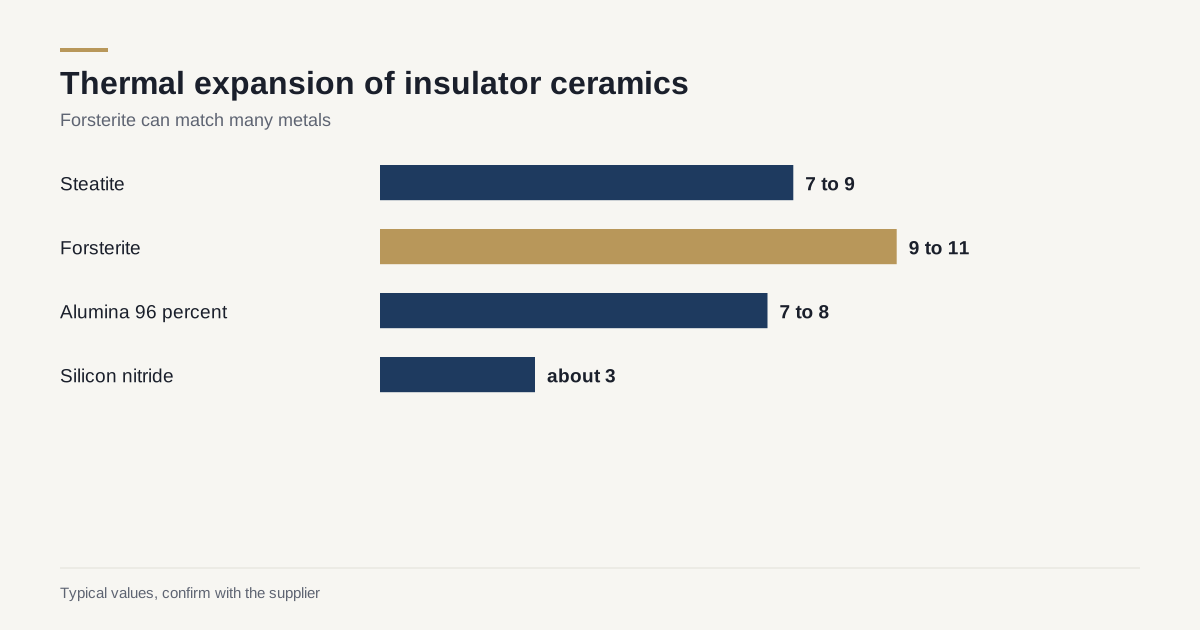
Forsterite is richer in magnesia and fires to a different crystal phase, magnesium orthosilicate. It has little glassy phase. The result is lower dielectric loss than steatite and a thermal expansion that is much higher, close to that of several common metals.
Typical properties
| Property | Steatite | Forsterite | Alumina, 96 percent |
|---|---|---|---|
| Main phase | Enstatite plus glass | Forsterite | Corundum plus glass |
| Density | About 2.6 to 2.9 g/cm3 | About 2.8 to 3.0 g/cm3 | About 3.7 g/cm3 |
| Flexural strength | About 100 to 160 MPa | About 100 to 140 MPa | About 300 MPa |
| Dielectric constant at 1 MHz | About 5.5 to 6.5 | About 6 to 7 | About 9 |
| Dielectric loss tangent at 1 MHz | About 0.001 | About 0.0002 to 0.0005 | About 0.0003 to 0.001 |
| Thermal expansion | About 7 to 9 ppm per K | About 9 to 11 ppm per K | About 7 to 8 ppm per K |
| Thermal conductivity | About 2 to 3 W/mK | About 3 to 4 W/mK | About 20 to 25 W/mK |
| Typical maximum use | About 1000 degrees C | About 1000 to 1100 degrees C | About 1500 degrees C |
These are typical ranges from published data and producer sheets. Grades vary, so take the figures for the grade you buy. IEC 60672 groups ceramic insulating materials into families and gives property limits for each, so name the class on a drawing if you work to that standard.
Where steatite fits
- Heating appliance parts. Element supports, bobbins and spacers in toasters, heaters and ovens, where temperature is moderate and the cost has to stay low.
- Terminal blocks and fuse bodies. Electrical safety parts that need tracking resistance and strength at a fair price.
- Low and medium frequency electronics. Coil formers and tube spacers where the loss is acceptable.
- High volume parts. Dry pressing makes thousands of identical pieces quickly. See dry pressing vs isostatic pressing.
Steatite is a poor choice where heat flows through the part. The conductivity is low. It also has less strength than alumina, so sections are made thicker.
Where forsterite fits
- Ceramic to metal seals. The expansion lets forsterite pair with certain alloys without large stress on cooling. Metallised forsterite is used in vacuum feedthroughs and electron tube envelopes. See ceramic insulators for vacuum feedthroughs.
- High frequency insulators. The very low loss makes it useful where steatite starts to heat in the field.
- Parts that must match a metal housing’s expansion. A high expansion ceramic is easier to fit into a metal sleeve across a temperature swing.
Forsterite has weaker thermal shock behaviour than many ceramics, so sudden temperature changes can crack it. Read thermal shock testing before using it near a burner or a rapid heater.
Why alumina is not always the better choice
Alumina offers more strength, higher temperature limit and much better heat conduction. It also costs more to buy and more to fire. If a part sees low load, moderate temperature and no need to move heat, the extra capability of alumina is wasted. In that case a steatite part may cost a fraction of the price and still meet the specification.
Where alumina is the correct choice: heat to remove, loads to carry, temperature above about 1000 degrees C, or high mechanical stress. For help comparing, see choose a ceramic by property.
Making and finishing the parts
The standard route for steatite and forsterite is dry pressing from a spray-dried powder, then firing at roughly 1250 to 1400 degrees C, depending on grade. Shrinkage in the kiln is about 12 to 16 percent in linear dimension. Parts come out with tolerances of around 1 to 2 percent as fired, which suits many electrical parts without further work.
Where a fit matters, the fired part is diamond ground. These bodies grind more easily than alumina because they are softer, but they still need diamond tooling and the same care with edges. See how diamond grinding works. Glazing is common on steatite insulators, which gives a smooth, non-absorbent surface that resists moisture and tracking. See glazing and sealing porous ceramic parts.
Electrical behaviour in more detail
Three electrical figures decide most insulator choices, and each behaves differently with temperature and frequency.
- Volume resistivity. At room temperature all of these materials are excellent insulators. As temperature climbs, resistivity falls by orders of magnitude. A heater support running at 800 degrees C is a much poorer insulator than the same part at 20 degrees C, and the fall is steeper in bodies with more glassy phase. For heating work, ask for resistivity at the operating temperature, not at room temperature.
- Dielectric loss. The loss tangent sets how much radio frequency energy turns into heat inside the part. Forsterite stays low across a wide frequency range. Steatite is fine at mains and audio frequencies but becomes lossy as frequency and temperature rise together.
- Tracking and surface leakage. In damp or dirty air, current can creep along the surface. A smooth glazed surface resists it. A rough unglazed one collects moisture and dust. Creepage distance on the drawing and the surface finish together decide whether the part passes a safety test.
If the part is mains voltage safety equipment, follow the product standard for creepage and clearance. This guide gives the material side, and the standard gives the pass or fail.
Quality points specific to these bodies
- Firing consistency. A magnesium silicate body has a narrow firing range. A kiln that runs a little hot or cold changes porosity and shrinkage, so reputable shops control and log the firing.
- Density check. A simple water absorption test shows whether the lot fired properly. Fully vitrified parts absorb almost no water.
- Warp and flatness. Large flat parts warp more than small ones, so flatness on a pressed and fired plate is looser than on a ground one.
- Colour. Steatite is usually white to cream. Colour shifts can signal a firing change and are worth a question.
Common mistakes
- Assuming a datasheet figure applies at temperature. Insulation resistance drops as the temperature climbs, in these materials faster than in alumina.
- Ignoring moisture on unglazed parts. Open pores absorb water and lower surface resistance in damp conditions.
- Using steatite in a sealed vacuum part. Porosity and outgassing can be a problem. Choose a dense, vacuum-grade body.
- Overlooking expansion mismatch. A steatite part clamped in a metal sleeve can crack as it heats if the metal expands more.
Checklist for the RFQ
- Name the material family and the class if you use a standard.
- State peak and continuous temperature, and whether there are rapid changes.
- State voltage, frequency and the insulation resistance or loss you need.
- State whether glaze is required and on which faces.
- Give the as-fired tolerance you accept and mark the ground faces.
- State the annual volume, so the shop can choose between pressing and grinding from blanks.
To find shops that handle these materials, send the drawing and the electrical requirement through the RFQ page.
Frequently asked questions
What is the difference between steatite and forsterite?
Both are magnesium silicate ceramics. Steatite is based on the mineral enstatite and is the general purpose, low cost grade. Forsterite has a different crystal phase, a higher thermal expansion that matches many metals and a lower dielectric loss, at a higher price and lower thermal shock resistance.
Can steatite be used above 1000 degrees C?
Typical grades are rated to about 1000 degrees C or a little above for continuous use, with the exact figure set by the grade. Above that, creep and loss of insulation resistance start, and alumina is the next choice.
Are steatite parts ground after firing?
Many are used as fired, pressed to near net shape. Where tolerance matters, the fired part can be diamond ground. Plan for the usual firing shrinkage and the usual stock allowance.
Need a quote for this part?
Send the drawing. We match you with up to 3 shops that grind this grade and reply within 24 business hours.
Get matched with a ceramic shop