Guides / Materials
Machinable Aluminium Nitride: Heat Conduction Without the Grinding Queue
October 25, 2026
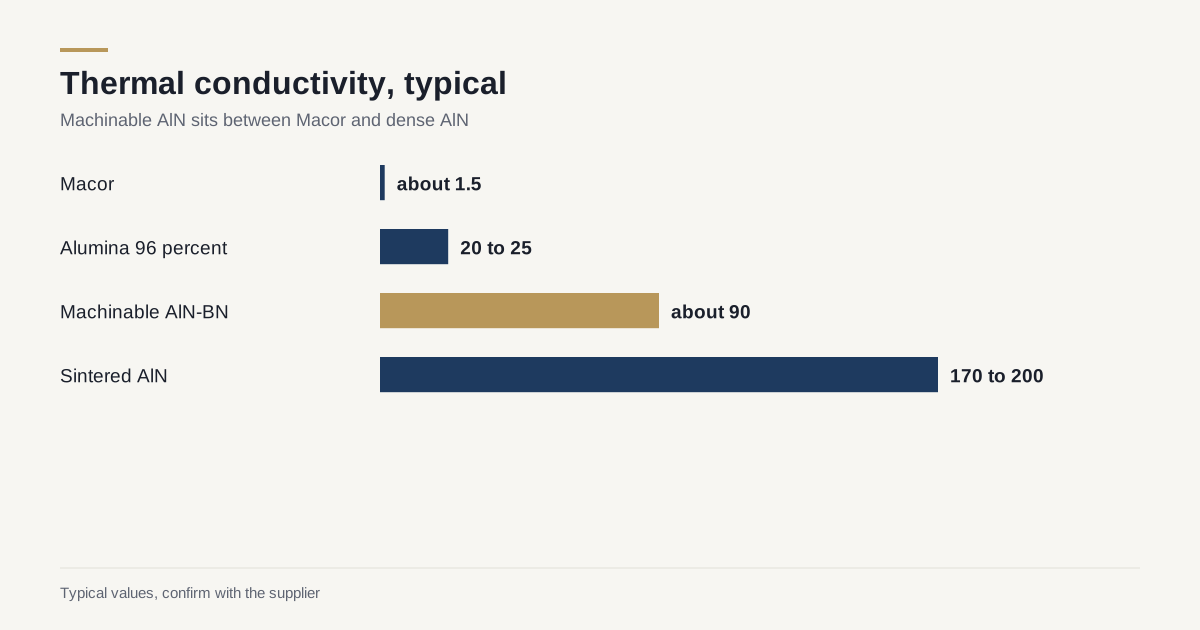
Aluminium nitride moves heat better than almost any electrical insulator, which is why it appears in power electronics and semiconductor tools. It is also hard to make into custom shapes. Sintered AlN has to be ground with diamond, and every prototype or small run pays for that work.
Machinable aluminium nitride composites, with Shapal Hi-M Soft the best known, offer a way around the problem. A boron nitride phase in the body lets standard carbide tooling cut it. No firing follows, so the part comes off the machine finished. The price of that convenience is lower thermal conductivity and lower strength than dense AlN.
What the material is
The composite contains aluminium nitride grains and hexagonal boron nitride in a dense body. The AlN grains carry the heat. The boron nitride platelets act as a soft, lubricating phase, and they let a cutting edge shear material away without cracking it. The structure is hot pressed, so the billets are dense with no open porosity to speak of, which makes the material vacuum compatible.
Different producers use different recipes. Shapal Hi-M Soft is a branded product from one manufacturer. Other machinable AlN-BN grades are sold under their own names. They behave in a similar way, but their exact figures differ, so always work from the datasheet of the grade a shop will actually supply.
Typical properties
| Property | Machinable AlN-BN composite | Sintered AlN | Macor | Alumina 96 percent |
|---|---|---|---|---|
| Thermal conductivity | About 90 W/mK | About 170 to 200 W/mK | About 1.5 W/mK | About 20 to 25 W/mK |
| Flexural strength | About 300 MPa | About 300 to 400 MPa | About 94 MPa | About 300 MPa |
| Thermal expansion | About 5 ppm per K | About 4.5 ppm per K | About 9 ppm per K | About 7 to 8 ppm per K |
| Dielectric constant at 1 MHz | About 7 | About 8.5 to 9 | About 6 | About 9 |
| Machining method | Carbide tools, no firing | Diamond grinding | Carbide tools, no firing | Diamond grinding |
| Relative price | High | Moderate to high | High | Low |
All figures are typical published values and they depend on the producer and the grade. Check the datasheet for any property that decides the design.
Why machinable AlN exists
For a prototype or a part made in low volume, grinding sintered AlN means a billet, a long diamond grinding cycle and an expensive set of programs. The machinable composite changes the economics.
- Speed. Parts can be turned and milled within days, with the geometry changed easily between versions.
- Complex shapes. Pockets, small holes, threads and fine features that grinding struggles to make.
- No firing distortion. There is no sintering step, so no shrinkage to compensate.
- Good vacuum behaviour. Dense and clean, with no glassy phase that outgasses badly.
It also matches silicon’s thermal expansion more closely than alumina does, which helps when a part sits against a semiconductor die or wafer. See aluminium nitride vs alumina for heat paths for the conductivity comparison.
What you give up
- Heat conduction. About half of the dense grade’s performance, though still several times that of alumina.
- Strength and hardness. The soft phase that makes it machinable also makes it wear faster than dense ceramics.
- Cost. It is a specialty billet product, usually priced well above alumina.
- Moisture sensitivity. Aluminium nitride can hydrolyse in water over time. Ask the supplier about storage and coolants.
- Size range. Billets come in limited sizes, which restricts large parts.
For parts needing top thermal performance, volume or hard wear surfaces, sintered AlN ground to size is still the better route.
Joining and finishing
Machinable AlN can be bonded, clamped, brazed or metallised, but each route has its own watch points.
- Clamping and bolting. The soft phase means a bolt head can crush the surface. Use washers that spread the load and avoid point contact.
- Thermal interface. If the part is meant to move heat, the interface to the next part matters as much as the material. A flat, lapped surface and a thin layer of thermal compound or foil usually outperform a rough dry joint by a wide margin. See lapping, polishing and flatness.
- Metallising and brazing. Possible with suitable processes, but the temperatures and atmospheres must suit the boron nitride phase. Discuss it with the shop before committing. See metallising and brazing ceramic to metal.
- Surface finish. A machined surface is smooth but not polished to an optical standard. Fine grinding or lapping improves flatness, within what the soft phase allows.
A worked comparison
Suppose a research team needs a sample stage that holds a small device and spreads the heat from it into a cooled block in vacuum. The stage is 30 mm square, with a step, two threaded holes and a shallow pocket. They will probably change the pocket twice.
Alumina would give a stage at lower cost but would conduct heat poorly, so the device would run hot. Sintered AlN would conduct well, yet each version would be ground with diamond, with a waiting time and a cost per attempt. Macor would be easy to cut but would act almost as a thermal insulator.
Machinable AlN lets them cut each version in days and still get a good heat path, at roughly half the conduction of the dense grade. When the design settles and quantities rise, they can move to a ground sintered AlN part and gain the extra conduction. This is the typical use of the material: bridging the design phase.
Where it is used
- Semiconductor equipment. Insulating spacers, heater plates, wafer handling parts and chuck components where heat spreading matters. See ceramic parts in semiconductor equipment.
- Vacuum and instrument parts. Sample holders and supports that must carry heat in a vacuum.
- Prototype heat spreaders. A machinable stand-in for a later sintered part.
- Power electronics test fixtures. Insulating blocks that carry heat from a device.
Machining notes
Machinable does not mean the same as easy. Observe these points.
- Dry or approved coolant. Water-based coolants can attack some AlN surfaces. Use dry cutting with air and dust extraction, or a coolant the supplier approves.
- Sharp carbide tools. Dull tools chip edges. Edges need small chamfers.
- Light cuts. Heavy cuts can chip features.
- Dust. The powder contains boron nitride and aluminium nitride, so extraction and protective equipment are standard.
- Tolerance. Around ±0.013 to ±0.025 mm is routine on a small feature.
- Cleaning. Ultrasonic cleaning in a suitable fluid and dry out before use in vacuum.
The comparison with the other machinable ceramics is in when Macor is the right choice and machinable boron nitride.
A decision path
- Is the part a prototype or a very small run? If yes, machinable AlN is a strong candidate.
- Does the part carry heat? If conduction is critical, compare 90 W/mK with the dense grade’s 170 or more.
- Does the geometry need fine features that grinding handles badly? Machinable AlN helps.
- Is it a volume part with simple geometry? Choose sintered AlN, ground.
- Does the part wear or see load? Choose a dense ceramic.
Checklist for the RFQ
- Name the grade, or give the thermal conductivity you need and let the shop propose one.
- State the vacuum level, bakeout temperature and cleanliness requirement.
- Give tolerances and mark critical features.
- State whether coolant is allowed.
- Give quantity and the chance of design changes.
- Ask for billet lot and property data from the producer.
The machinable family is compared in one table in ceramic material selection.
To reach shops that cut these billets, describe the part in an RFQ.
See also: the aluminium nitride reference page.
Frequently asked questions
What is Shapal Hi-M Soft?
It is a machinable ceramic made from aluminium nitride and boron nitride. The boron nitride lets it be cut with carbide tools, and the aluminium nitride gives it good thermal conductivity. It is a commercial grade from one producer, and similar composites exist from others.
Does machinable aluminium nitride conduct heat as well as dense AlN?
No. Typical figures are about 90 W/mK for the machinable composite against 170 W/mK or more for standard sintered AlN. It still conducts far better than Macor or alumina in many cases.
Can I use water-based coolant when cutting it?
Ask the supplier. Aluminium nitride can react slowly with water, and many shops cut machinable AlN dry or with a coolant the supplier approves. Do not assume a standard coolant is safe.
Need a quote for this part?
Send the drawing. We match you with up to 3 shops that grind this grade and reply within 24 business hours.
Get matched with a ceramic shop