Guides / Materials
Machinable Boron Nitride: What It Does Well and Where It Lets You Down
October 22, 2026
Boron nitride is the odd one out in the technical ceramic family. Most ceramics are hard, strong and expensive to cut. Hot pressed hexagonal boron nitride, often shortened to hBN, is soft, slippery and machines like a dense plastic or a soft metal. It also insulates electrically, conducts heat reasonably well, survives very high temperature in inert gas and does not get wetted by most molten metals.
That combination makes it a favourite for furnace and vacuum work. It also makes it easy to specify in the wrong place, so the limits matter as much as the strengths.
What it is
Boron nitride is built from alternating boron and nitrogen atoms in a lattice that mirrors carbon. In its hexagonal form the atoms sit in flat layers that slide over one another, much like graphite, which is why it is soft and has a low friction surface. It is white, which earns it the nickname white graphite, but unlike graphite it is an electrical insulator.
Machinable blocks and rods are made by hot pressing hBN powder, usually with a small amount of binder, into a dense billet. The binder is a main difference between grades. Grades with a boric oxide binder pick up moisture from the air and swell slightly. Grades with a calcium borate binder resist moisture better. Pure grades with no binder are more stable but cost more and have lower density.
A different form, pyrolytic boron nitride, is deposited from gas as a layered shell. It is used for crucibles and special parts and is not machined in the same way.
Typical properties
| Property | Typical value for hot pressed hBN | Comment |
|---|---|---|
| Density | About 1.9 to 2.3 g/cm3 | Lower than alumina by a large margin |
| Flexural strength | About 20 to 100 MPa | Varies with grade and direction |
| Hardness | Very soft, close to Mohs 2 | Scratches with a fingernail on some grades |
| Thermal conductivity | About 20 to 60 W/mK | Often higher in one direction |
| Thermal expansion | Low, about 1 to 5 ppm per K | Direction dependent |
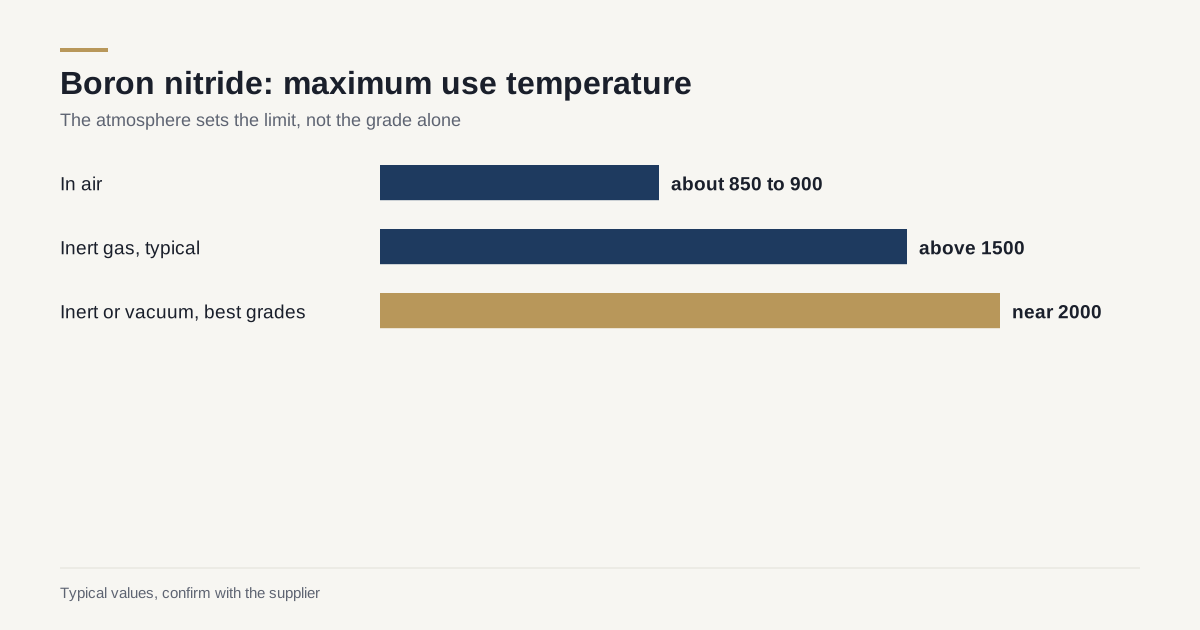
| Maximum use in air | About 850 to 900 degrees C | Oxidation sets the limit |
| Maximum use in inert gas or vacuum | Above 1500 degrees C, some grades near 2000 | Grade dependent |
| Electrical behaviour | Insulator | Good at high temperature |
All figures are typical and vary by producer. Take the datasheet of the grade you actually buy and note that properties often differ along and across the pressing direction.
Where it earns its place
- Furnace parts. Insulators, heater supports, thermocouple sleeves and setters in vacuum and inert gas furnaces.
- Molten metal contact. Crucibles, nozzles and break rings that handle molten metal without being wetted.
- Semiconductor and plasma equipment. Insulating parts that must stand heat and not contaminate. See ceramic parts in semiconductor equipment.
- Electrical insulation at high temperature. Standoffs and spacers where an organic insulator would burn.
- Thermal management. Where a machinable electrical insulator must carry heat away.
What it costs you
The weakness list is long and honest.
- Strength. It cannot take structural load, bending or impact.
- Softness. It wears quickly against anything harder. Sliding contact with steel removes material.
- Porosity. Open pores trap moisture and contamination. In clean vacuum work, bake the parts out.
- Moisture. Boric oxide bound grades take up water, which can outgas in a vacuum system and can change dimensions.
- Oxidation. Above roughly 900 degrees C in air the material turns to boric oxide. Never assume that the inert gas rating also applies in air.
- Cost. The billet price is high for a soft material because the powder and hot pressing are costly.
Machining boron nitride
The machining is easy by ceramic standards and has its own rules.
- Tooling. Carbide tools are standard. Sharp edges give a clean cut. Diamond is not needed, though it lasts longer on production runs.
- Dry cutting. Avoid liquid coolants on bound grades, since they soak in. Use air and extraction.
- Dust. The fine powder is a nuisance and a health concern. The shop needs good dust collection. A buyer should expect a shop to say how it handles it.
- Tolerance. About ±0.025 mm is routine on a small feature, tighter with care. Soft material can deform under clamping.
- Surface. A smooth, slightly waxy finish. Handling marks show easily.
- Thin walls. They are fragile. Design walls of a millimetre or more where possible.
Compare this with the other machinable ceramics. When Macor is the right choice describes a stronger, glassier alternative that works in air to a lower temperature. For a machinable option that also moves heat, see Shapal and other machinable aluminium nitride.
Handling, storage and cleaning
Because the material is soft and porous, care between the machine and the furnace matters.
- Store dry. Keep bound grades in sealed bags with a desiccant. A part that sat in a humid store will outgas on its first heat-up.
- Bake out before vacuum use. A dry bake at a moderate temperature before installation removes absorbed water. The shop or the user can do this.
- Wear gloves. Skin oils soak into the surface and show as carbon or sodium on first heating.
- Do not wash with liquids. Use clean dry air or a soft brush to remove dust. A solvent wipe leaves residue in the pores.
- Use soft fixtures. Hard clamps leave dents. Machinists use soft jaws or wax and plastic holders.
A worked example
Consider a heater support in a vacuum furnace that runs at 1600 degrees C. The support must insulate the heater from the frame, it sees almost no load and it must not react with the hot zone. Alumina would soften under creep and can react with some heater materials at that temperature. Boron nitride is a natural fit. The support is turned from a billet, fitted with stepped bores for the heater leads and installed after a dry bake.
Now change one fact: the same furnace is opened to air for a bake-out at 1000 degrees C. The support begins to oxidise, the surface turns glassy and the part loses dimension. The fault lies in the specification, not the material. A requirement that listed only the peak temperature and not the atmosphere would have allowed that failure. The atmosphere belongs on the drawing as much as the temperature.
Boron nitride compared with the alternatives
| Need | Boron nitride | Alternative |
|---|---|---|
| Insulator above 1500 degrees C in vacuum | Strong choice | Alumina, if strength is needed |
| Insulator in air above 900 degrees C | Not suitable | Alumina, steatite, mullite |
| Non-wetting for molten metal | Strong choice | Graphite, if electrical conduction is acceptable |
| Structural load | Not suitable | Alumina, zirconia, silicon nitride |
| Fast prototype in a ceramic | Good | Macor, if temperature allows |
Checklist for the RFQ
- Name the grade or binder type, or state the environment and let the shop propose one.
- State the atmosphere and the peak temperature, with duration.
- Give the moisture and outgassing limits for vacuum use.
- State the tolerance and note which features are critical.
- Ask how the shop controls dust and handles the blanks to avoid contamination.
- Ask for the billet lot and the property data from the supplier.
For how boron nitride compares with Macor and machinable aluminium nitride, see ceramic material selection.
If boron nitride fits your application, send the drawing through the RFQ page with the atmosphere and temperature, and the matched shops will confirm the grade.
Frequently asked questions
Can boron nitride be machined with ordinary tools?
Yes. Hot pressed hexagonal boron nitride is soft enough to turn, mill and drill with carbide tooling, and it needs no firing afterwards. Machine it dry, because many grades absorb liquid, and use dust extraction since the powder is fine.
How hot can boron nitride go?
In air, oxidation starts around 850 to 900 degrees C, which sets the practical limit. In vacuum or inert gas, hot pressed grades work to well above 1500 degrees C, and some grades to around 2000 degrees C. Check the grade's own datasheet.
Is boron nitride strong?
No. It is one of the weakest technical ceramics in bending and it is very soft. It is chosen for heat, electrical insulation and non-wetting behaviour, not for load.
Need a quote for this part?
Send the drawing. We match you with up to 3 shops that grind this grade and reply within 24 business hours.
Get matched with a ceramic shop