Guides / Materials
Sapphire or Alumina: Same Chemistry, Very Different Parts
October 24, 2026
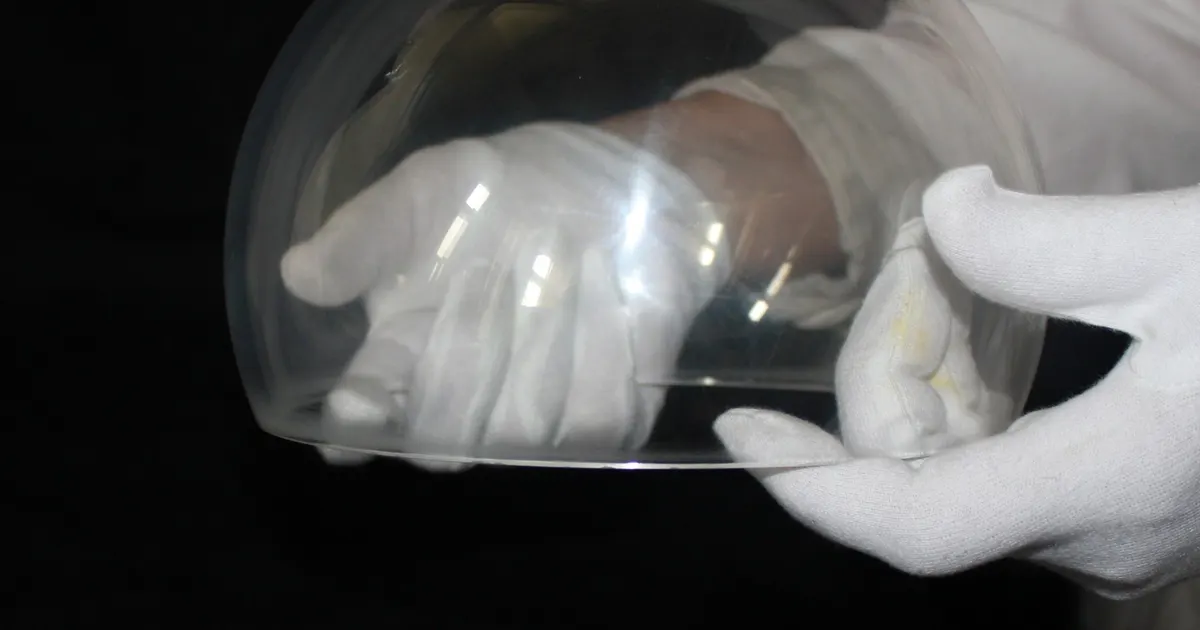
Sapphire and alumina are the same compound, aluminium oxide. A buyer who sees both on a datasheet may wonder why the price differs by a large factor and whether the extra cost buys anything. The answer lies in the structure. Sapphire is one large crystal with no grain boundaries. Alumina ceramic is a dense mass of tiny crystals, each pointing in a different direction, joined at boundaries that often hold a trace of glassy phase.
That structural difference decides optics, surface quality, wear behaviour and cost. This guide sets the two side by side.
How each is made
Sapphire is grown from molten aluminium oxide. Common routes include the Kyropoulos and heat exchanger methods, which grow large boules, and edge-defined film-fed growth, which pulls shaped rods, tubes and ribbons directly from the melt. The grown crystal is then cut, ground and polished along a chosen crystal plane. Growth takes days and the furnace time is expensive.
Alumina ceramic is made from powder. Fine powder is pressed, injected or cast to a shape and sintered, typically at 1500 to 1700 degrees C. The result is a dense polycrystalline body in a range of purities, most commonly 96, 99.5 and 99.8 percent. See which alumina purity do you need for the trade-offs.
Properties side by side
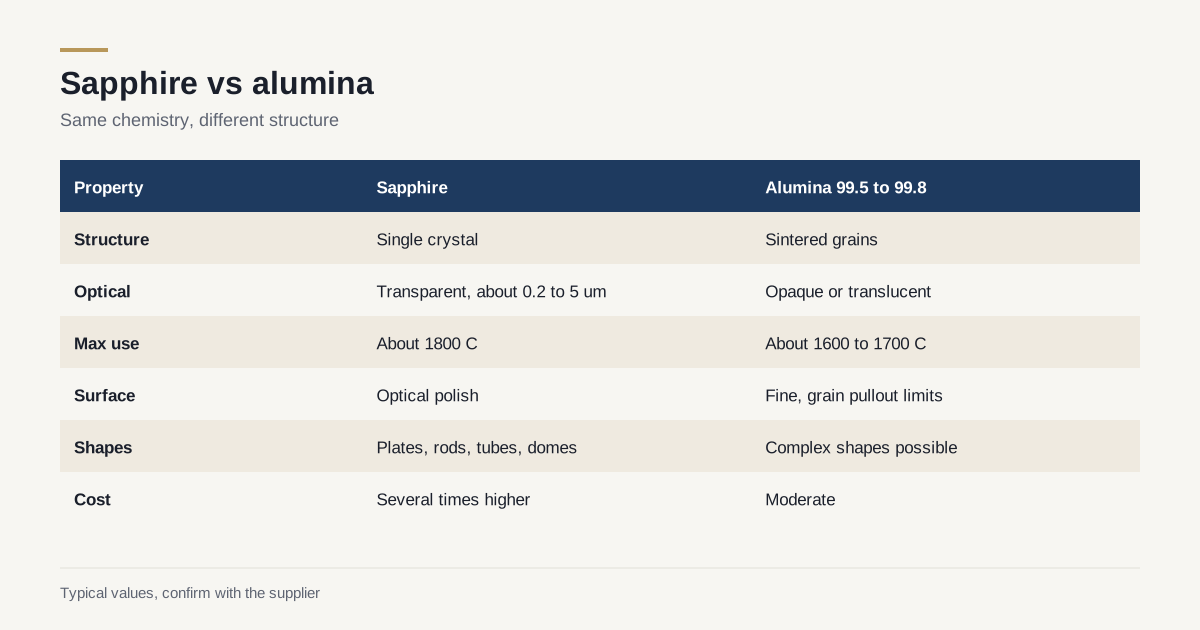
| Property | Sapphire | Alumina, 99.5 to 99.8 percent |
|---|---|---|
| Structure | Single crystal | Polycrystalline, grain size of a few micrometres |
| Hardness | Very high, about Mohs 9 | Very high, slightly lower |
| Optical | Transparent, roughly 0.2 to 5 micrometres | Opaque, or translucent in special grades |
| Thermal conductivity | About 25 to 35 W/mK at room temperature | About 25 to 35 W/mK |
| Maximum use temperature | Around 1800 degrees C in suitable atmospheres | Around 1600 to 1700 degrees C |
| Flexural strength | Very dependent on surface and orientation, often several hundred MPa | About 300 to 400 MPa |
| Surface roughness achievable | Optical polish, sub-nanometre on small areas | Very fine, but grain pullout limits it |
| Cost | High, several times that of alumina | Moderate |
The numbers are typical ranges. Check each against the grade and supplier you plan to use, because sapphire values in particular depend on orientation and growth method.
Where sapphire wins
- Optical windows. Anything that has to pass visible or infrared light. Pressure windows, sight glasses, laser and sensor covers, analytical instruments. Alumina cannot match it.
- Scratch resistance with clarity. Watch crystals and cover glasses keep their finish under abrasion.
- Very smooth surfaces. A sapphire surface can be polished to optical flatness with no grain structure to pull out. See lapping, polishing and flatness.
- Clean, high-temperature service. No glassy grain boundary phase means that sapphire does not shed sodium or silica at high temperature, which matters in semiconductor work.
- Fine orifices and wear parts with extreme finish. Sapphire orifices and guides keep a smooth bore in service.
Where alumina wins
- Cost. For most structural, insulating and wear parts, alumina costs a fraction of sapphire.
- Shape freedom. Pressing, injection molding and grinding give complex shapes. Sapphire shapes are mostly limited to what growth and diamond grinding can make: plates, discs, rods, tubes, domes and simple profiles.
- Size. Large alumina parts, such as plates and long tubes, are routine. Large sapphire parts are costly and scarce.
- Machining and joining. Alumina can be metallised and brazed with well known processes. See metallising and brazing ceramic to metal. Sapphire can be joined too, but fewer shops do it.
- Lead time. Standard alumina stock shapes are quick to supply.
Pitfalls specific to sapphire
- Cleavage. A single crystal fractures more easily along certain planes. A part loaded or struck in the wrong direction can split cleanly where a polycrystal would resist.
- Orientation. The crystal axis matters for strength, optics and thermal expansion. The drawing should state the cut, such as C-plane or A-plane, when it matters.
- Birefringence. Non-cubic crystals split light into two rays depending on direction. For imaging optics this must be accounted for, and the cut chosen so that the optical axis lines up with the beam.
- Edge chipping. The hard, brittle crystal chips at edges. Chamfers and edge radii are specified on nearly every sapphire drawing.
- Thermal shock. It handles moderate change, but a very sharp temperature step on a thick sapphire plate can crack it. Check the duty cycle. See thermal shock testing.
The middle path: translucent alumina
Between the two sits translucent polycrystalline alumina. Very fine grains and almost no porosity let some light through, which is how lamp tubes and some dental brackets are made. The material does not reach sapphire’s clarity, because grain boundaries still scatter light, and it does not transmit well into the infrared. It does cost less than sapphire and can be formed into tubes and shapes that sapphire growth cannot match economically. If your requirement is “lets light through” and not “optical window”, ask a shop whether this grade could work. Reaching that level of density usually involves a vacuum or hydrogen sinter and sometimes hot isostatic pressing.
How the price gap shows up
A rough sense of scale helps. A plain alumina disc of 25 mm diameter and a few millimetres thick, ground flat, is among the cheapest technical ceramic parts you can buy. A sapphire window of the same size with an optical polish may cost many times more, since the boule must be grown, sliced, ground and polished on both faces. The ratio narrows when the alumina part is complex and widens when the sapphire part is simple, thin and made in volume.
Two factors drive sapphire pricing more than size: the polish specification and the yield. A tight flatness or scratch-dig requirement raises the reject rate, and the rejects add to the price of the survivors. Buyers who specify only what the function needs, not the finest polish a catalogue offers, often save more than any negotiation would.
A short example
An analytical instrument has a viewing port that must pass light and hold a pressure difference. A sapphire disc with a modest polish, bonded into a metal ring, does both jobs. An alumina disc cannot be used because it blocks the light. In the same instrument, the insulating spacer behind the window carries no light and no load, so it is alumina. One material per function, chosen for what it does, keeps the bill of materials sensible. For other instrument cases see ceramic parts for analytical instruments.
A decision path
Ask these questions in order.
- Does light have to pass through the part? If yes, sapphire. If translucence is enough, ask about a translucent alumina.
- Is a sub-nanometre polish or a grain-free surface needed? If yes, sapphire.
- Is a shape complex, large or volume driven? If yes, alumina.
- Is the cost a main driver and the only requirement hardness and insulation? Alumina.
- Is the part at the limit of alumina on temperature or purity? Consider sapphire.
For parts that need only hardness and electrical insulation, alumina is nearly always the right answer, and a buyer who specifies sapphire there pays for a property nobody uses.
Checklist for the RFQ
- State whether optical transmission is required and at which wavelengths.
- Give the surface finish and flatness, with the method used to measure them.
- Specify the crystal orientation if it affects performance.
- State chamfer and edge radius.
- Give the temperature range and the atmosphere.
- Ask for the growth method and the lot traceability for sapphire.
Sapphire is one option in the wider choice described in ceramic material selection.
If you are unsure which material the application needs, describe the function of the part in an RFQ and the matched shops will say what they would use and why.
Frequently asked questions
Is sapphire just expensive alumina?
Chemically yes, both are aluminium oxide. Physically no. Sapphire is a single crystal grown from a melt, alumina ceramic is a mass of fine grains sintered from powder. That difference gives sapphire its transparency and a cleaner surface, and it is why the price is several times higher.
Can an alumina part be transparent?
Fine grained translucent alumina can pass some light, often used for lamp envelopes, but it does not reach the clarity or the infrared range of sapphire. If you need an optical window, ask for sapphire.
Is sapphire stronger than alumina?
It can be stronger and it is harder, but strength depends heavily on surface finish and orientation, and sapphire cleaves along crystal planes. Do not choose it for strength alone, as a well made alumina part often does the same structural job at a fraction of the cost.
Need a quote for this part?
Send the drawing. We match you with up to 3 shops that grind this grade and reply within 24 business hours.
Get matched with a ceramic shop