Guides / Applications
Ceramic Plungers and Seal Faces: Specifying Wear Parts for Pumps
October 13, 2026
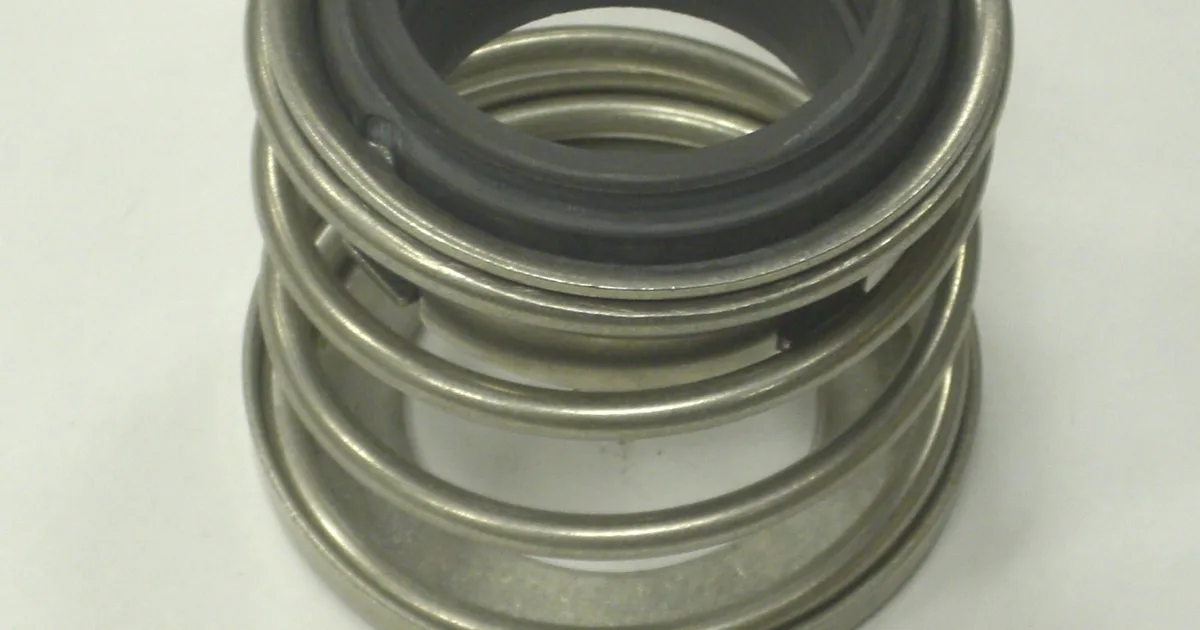
A pump moves fluid through a small gap between a moving part and a fixed one. In a reciprocating pump, the moving part is a plunger that slides through a packing. In a centrifugal pump, a seal keeps fluid in around a rotating shaft, and the heart of the seal is a pair of faces, one rotating and one fixed, that run against each other with a micrometre-thin film between them.
Both parts face hard working conditions: abrasive particles, corrosive fluid, heat and constant motion. That is why ceramic is a common choice, and why the specification matters.
Plungers: what they need
A plunger is a long, thin, round part that slides in and out of a packing set. The demands are:
- Surface hardness. Abrasive grit in the fluid would groove a steel plunger.
- Surface finish. A very smooth surface seals better and wears the packing less.
- Roundness and straightness. A bent or oval plunger wears the packing unevenly and leaks.
- Corrosion resistance. Many process fluids attack steel.
- Toughness. A plunger meets side loads and impact from pressure spikes.
Materials for plungers
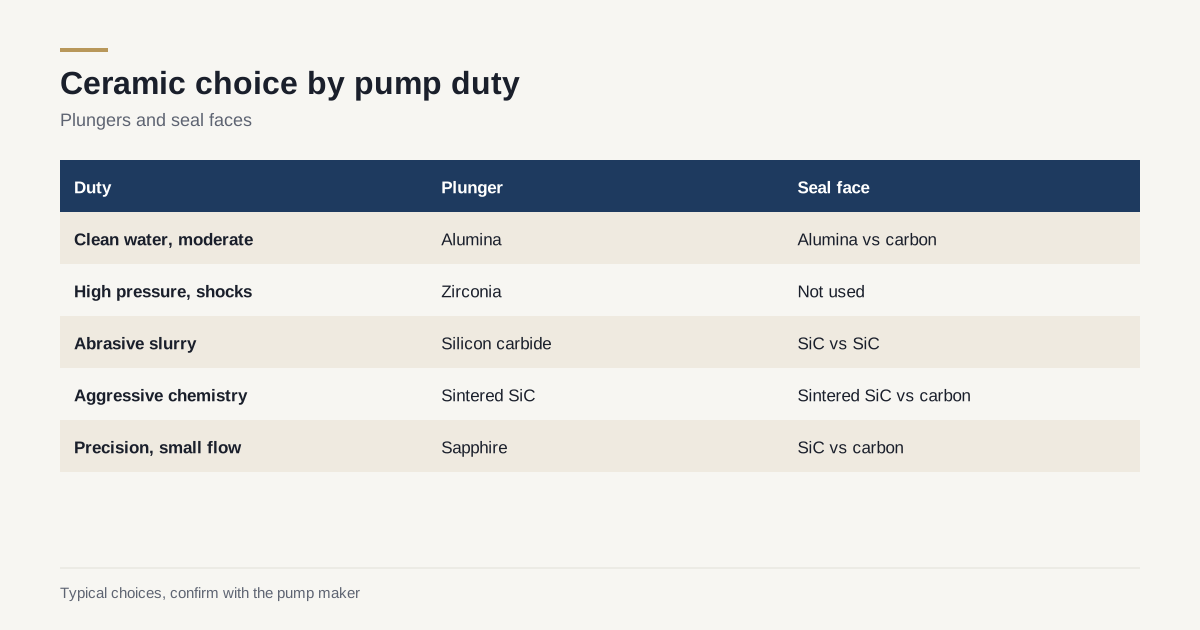
| Material | Strengths | Limits | Typical use |
|---|---|---|---|
| Alumina, 99.5 percent or better | Hard, low cost, good chemical resistance | Brittle, lower toughness | Metering pumps, moderate pressure |
| Zirconia, Y-TZP | Tough, very fine finish, resists impact | Temperature limit, ageing in hot water | High pressure pumps, waterjet, dosing |
| Zirconia toughened alumina | Between the two | Mid cost | General purpose |
| Sintered silicon carbide | Very hard, excellent corrosion resistance | Higher cost, less toughness than zirconia | Abrasive slurry, chemical duty |
| Sapphire | Very smooth, hard | High cost | Analytical and small precision pumps |
Zirconia in hot, humid service can suffer low temperature degradation, so for warm water above about 100 degrees C review zirconia ageing and low temperature degradation and choose a stabilised grade. For help choosing between grades, see zirconia grades explained.
Plunger drawing points
- Diameter tolerance. Often a few micrometres on a ground diameter.
- Roundness and cylindricity. Typically within one to two micrometres on a precision plunger.
- Straightness. Stated over the length, since a long thin ceramic rod bows easily.
- Surface roughness. Around Ra 0.05 to 0.2 micrometre, fine enough to avoid cutting the packing.
- End features. Chamfers, a thread or an attachment seat, often by bonding or clamping to a metal holder.
- Joining. A ceramic plunger is usually fixed to a steel stem by adhesive or a mechanical clamp. See metallising and brazing ceramic to metal for fixed joint options.
Seal faces: what they need
A mechanical seal uses two flat rings, one fixed and one rotating, pressed together by springs. A very thin fluid film between them lubricates the faces and limits leakage. For this film to hold, the faces must be extremely flat and extremely smooth.
The demands are:
- Flatness. A typical lapped face is flat to about 0.6 micrometre or better, which equals two helium light bands. One helium light band is about 0.29 micrometre. Many designs ask for 1 to 3 bands.
- Surface roughness. About Ra 0.05 to 0.2 micrometre, depending on design.
- Wear resistance. Slurries and film breakdowns put abrasion on the faces.
- Thermal conductivity. The faces generate heat from friction, and a conductive material carries it away, which protects the faces from heat checks.
- Chemical resistance. The fluid cannot attack the ring.
Common face pairs
| Pair | Typical duty | Notes |
|---|---|---|
| Alumina against carbon | Water, mild chemicals | Low cost, wide use |
| Silicon carbide against carbon | Most industrial fluids | Good heat conduction and chemical resistance |
| Silicon carbide against silicon carbide | Abrasive or corrosive fluids | Needs lubrication, can be damaged dry |
| Tungsten carbide against silicon carbide | Heavy duty, high pressure | Heavy and costly |
Reaction-bonded SiC works in neutral fluids, while sintered SiC is the choice for aggressive chemistry. Read reaction-bonded vs sintered silicon carbide before picking a grade.
Seal face drawing points
- Flatness in light bands, with the measurement method, for example optical flat and monochromatic light.
- Roughness. State Ra and the measurement direction.
- Parallelism of the two faces of the ring.
- Edge chamfers. Small, uniform chamfers prevent chipping on handling and in service.
- Secondary sealing surface. The back and bore also need finish, since an O-ring or gasket seals there.
- Material grade. Name the base material and process route.
For how such flatness is made, read lapping, polishing and flatness.
Installation and running-in
Many ceramic wear part failures start at installation, not in service.
- Clean everything. A grain of grit trapped between a seal face and its holder can crack a face on the first spring load.
- Do not touch the lapped surface. Skin oil changes the film behaviour for the first running minutes, and a fingernail can scratch a fine finish.
- Align the parts. A plunger that enters the packing at an angle takes bending load, and ceramics resist that poorly.
- Fit seats evenly. An uneven seat under a face distorts it and costs the flatness you paid for. The holder should support the ring over its full back face.
- Run in gently. Start with the fluid film in place and avoid dry starts. Many seals tolerate a short dry start on carbon against ceramic, but not for long.
- Keep records. Note the lot, the run hours and the cause of removal, so the next order can be improved.
A worked example
A dosing pump moves a mildly abrasive mineral slurry at moderate pressure. The plunger was hardened steel, which scores in a few weeks and takes the packing with it. The plant switches to a 99.7 percent alumina plunger ground to Ra 0.1 micrometre. Life rises from weeks to many months, and the packing lasts longer too. A pressure spike from a blocked line then snaps one plunger across the middle. The next order is zirconia: it costs more per piece and tolerates the spike. The plant now runs on a plunger that suits the fluid and the real duty, including its worst day.
The lesson is to specify for the worst realistic event as well as the average day. Hardness solves wear, and toughness solves shock. The right ceramic often depends on which of the two hurts you more.
Why ceramics beat steel here
A steel plunger or face wears quickly in slurry. A ceramic part can last many times longer, which means fewer shutdowns. It also resists corrosion in acids and brines that attack stainless steel and can be cheaper over its life than a coated metal part. The trade-off is brittleness. Thermal shock, dry running and impact are the usual causes of ceramic wear part failures.
What goes wrong
- Dry running. A seal that loses its fluid film heats up and cracks the faces. Silicon carbide against silicon carbide is especially exposed.
- Thermal shock. A cold flush on a hot face can crack it. See ceramic thermal shock testing.
- Chipping at edges. From handling or misalignment. See corner radius and edge chipping.
- Bent plungers. Ceramic is stiff but long thin rods deflect with side load, which can break them.
- Wrong zirconia grade in hot water.
Checklist for the RFQ
- Fluid, concentration, temperature and the presence of solids.
- Pressure and speed.
- Ceramic grade and process route, or the duty so the shop can propose one.
- Dimensional and form tolerances: diameter, roundness, straightness, flatness.
- Surface roughness and measurement method.
- Edge chamfers and radii.
- Mating material, such as carbon, SiC or packing type.
- Inspection reports requested.
To find shops that grind and lap these parts, describe the duty and send the drawing through the RFQ page.
See also: the sintered silicon carbide reference page.
Frequently asked questions
Which ceramic is best for a mechanical seal face?
Sintered silicon carbide is the most common choice for hard or corrosive service, run against carbon or against another silicon carbide face. Alumina is a lower cost option for mild fluids. Zirconia is rarely used for faces because it conducts heat poorly.
Why are zirconia plungers popular in high pressure pumps?
Zirconia is tough for a ceramic, so it tolerates the impact and bending a plunger sees better than alumina does. It also grinds to a very fine, round surface that seals well against packing. Its limit is temperature and certain hot, wet duties.
What flatness does a seal face need?
A typical lapped seal face is flat to about 0.6 micrometre or better, which is two helium light bands, with a surface roughness of Ra 0.05 to 0.2 micrometre depending on the design. The seal maker's drawing sets the exact figures.
Need a quote for this part?
Send the drawing. We match you with up to 3 shops that grind this grade and reply within 24 business hours.
Get matched with a ceramic shop