Guides / Materials
Reaction-Bonded or Sintered Silicon Carbide: Two Routes, Two Sets of Limits
October 23, 2026
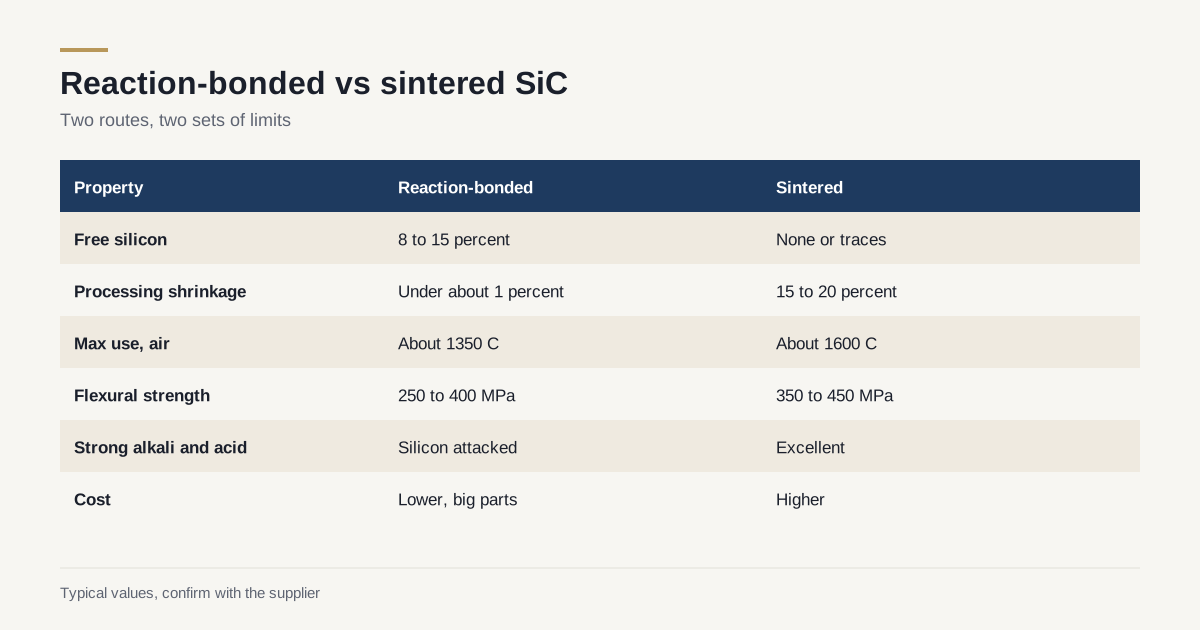
Silicon carbide is one of the hardest, stiffest and most heat-conductive engineering ceramics. It is also not one material. The two most common dense grades, reaction-bonded and sintered, come from very different processes and behave differently in service. Buyers who simply write “silicon carbide” on a drawing can receive either one, and the difference may decide whether the part survives.
This guide explains how each is made and what that means for size, chemistry, temperature and cost.
How reaction-bonded silicon carbide is made
A porous preform is shaped from silicon carbide powder and carbon. It is then placed in contact with molten silicon at roughly 1500 to 1650 degrees C. Capillary forces pull the silicon into the pores. The silicon reacts with the carbon to make new silicon carbide, which bonds the original grains together. Silicon fills the remaining space.
The result is a composite of silicon carbide grains in a matrix of silicon carbide and a few percent to about 15 percent metallic silicon. Because the preform does not densify by shrinking, the size change in processing is very small, often below 1 percent. That is the main selling point.
Sometimes called siliconised silicon carbide, or SiSiC, it is available in large and complex shapes.
How sintered silicon carbide is made
Very fine silicon carbide powder is mixed with small amounts of sintering aids, typically boron and carbon, pressed or cast to shape and fired at about 2000 to 2200 degrees C in an inert atmosphere. The grains fuse and the body densifies. It shrinks by about 15 to 20 percent and ends up almost pure silicon carbide.
Sometimes called SSiC, it has no free silicon. It costs more to make because of the high temperature, the shrinkage allowance and the hard grinding afterwards.
Typical properties
| Property | Reaction-bonded SiC | Sintered SiC |
|---|---|---|
| Free silicon | About 8 to 15 percent | None, or traces |
| Density | About 3.0 to 3.1 g/cm3 | About 3.1 to 3.15 g/cm3 |
| Flexural strength | About 250 to 400 MPa | About 350 to 450 MPa |
| Hardness | High, lower than sintered | Very high |
| Thermal conductivity | About 110 to 170 W/mK | About 80 to 140 W/mK |
| Maximum use temperature, oxidising | About 1350 degrees C | About 1600 degrees C |
| Shrinkage in processing | Under about 1 percent | About 15 to 20 percent |
| Acid and alkali resistance | Good, but silicon is attacked by strong alkalis and by hydrofluoric and nitric acid mixtures | Excellent |
| Relative cost | Lower, especially for large parts | Higher |
All values are typical and depend on the producer and the grade. Use datasheets for the grade you buy.
What the free silicon means
Free silicon melts at about 1410 degrees C. Above that, it softens and can sweat out of the part, so reaction-bonded SiC is limited to roughly 1350 degrees C in service. Below that limit it is stiff, strong and an excellent heat conductor.
Silicon is also the weak spot in aggressive chemistry. Strong alkaline solutions dissolve it and mixed hydrofluoric and nitric acids attack it. The silicon carbide skeleton survives, but the part loses material at the silicon pockets and its surface roughens. If a part sees such media, reaction-bonded SiC is the wrong choice.
The silicon also changes the surface: it polishes differently from silicon carbide grains and is softer, so wear rate in a sliding seal differs between the two grades.
Where reaction-bonded wins
- Large parts. Kiln beams, burner tubes, large plates and mirror substrates, where shrinkage of 15 to 20 percent would warp or crack a sintered part. Near-zero shrinkage keeps the blank close to its final dimension.
- Complex shapes. Casting a preform gives hollow and finned shapes.
- Lower cost. For large or intricate shapes, the processing is cheaper.
- Heat transfer. High thermal conductivity helps in heat exchangers and kiln furniture.
- Semiconductor and optics. Lightweight, stiff structures where chemistry is mild. See ceramic parts in semiconductor equipment.
Where sintered wins
- Aggressive chemistry. Acids and alkalis at high concentration.
- Higher temperature. Furnace parts above about 1350 degrees C.
- Mechanical seal faces and pump parts in hard service. Chemical purity and wear resistance. See ceramic pump plungers and seal faces.
- Very fine finish and tight tolerance. A uniform single phase takes a uniform polish.
- Strength and hardness. Sintered grades are usually a little higher on both.
Wear and sliding behaviour
For sliding parts, the microstructure matters as much as the base hardness. In reaction-bonded SiC the silicon phase is softer than the carbide grains, so in an abrasive slurry the silicon wears first, leaving the carbide grains standing proud. That can roughen the surface over time and, in a seal face, widen the leak path. In sintered SiC there is no soft phase, so the surface wears evenly and the finish holds for longer.
Both grades also hold up well against many hard counterfaces, including themselves, though a SiC against SiC pair can fail if the fluid film is lost and the faces run dry. Seal designers often pair SiC with carbon for that reason. If the part is a dry-running or marginally lubricated contact, the grade is only part of the story and the counterface choice matters just as much.
A worked example
A chemical plant needs a pump wear ring in a 30 percent sodium hydroxide solution at 80 degrees C. A reaction-bonded ring would look right on the datasheet, since silicon carbide is listed as alkali resistant, but the free silicon dissolves in hot caustic, the surface roughens and the ring loses its running clearance. A sintered ring of the same size does not. The price difference is small compared with a pump rebuild.
Take the reverse case: a 1.2 metre long burner support beam in a kiln at 1300 degrees C in air. A sintered beam of that length would be extremely hard to make straight, since it shrinks by 15 to 20 percent and sags in the kiln. A reaction-bonded beam arrives straight, near final size and with high conductivity, and the temperature is under the silicon limit. Each material is correct in its own case, and the deciding facts are the chemistry in the first and the size in the second.
Machining both
Neither grade can be cut with ordinary tools. Both are ground with diamond. Reaction-bonded SiC is a little easier at the start because the blank is already near size, so the grinder has less stock to remove. Sintered SiC arrives with the shrinkage already in the part, so extra stock must be allowed and the part may have warped in the kiln.
For hard-ground surfaces, both can reach fine finish and flatness, though a sintered body has a more uniform lapped surface. Read how diamond grinding works and lapping, polishing and flatness for what to expect. For comparing silicon carbide with silicon nitride on strength and toughness, see silicon carbide vs silicon nitride.
How to avoid getting the wrong one
- Write the grade, not only the base material. Say “sintered silicon carbide” or “reaction-bonded silicon carbide” on the drawing and the RFQ.
- Give the media and the temperature. The shop can then confirm whether free silicon is a risk.
- Ask for a statement of free silicon content or a confirmation that it is below a limit.
- Check marking and certificates. The producer’s grade name on the certificate shows which route made the part.
Checklist for the RFQ
- Grade type: reaction-bonded, sintered or open to either.
- Operating temperature and atmosphere.
- Media, with concentration and temperature if liquid.
- Size of the part and the tolerance on key faces.
- Whether free silicon is acceptable on functional surfaces.
- Volume, since sintered tooling and firing favour repeat runs.
To compare quotes for the two grades on your drawing, send it through the RFQ page and ask for each to be priced.
See also: the sintered silicon carbide reference page.
Frequently asked questions
What is the free silicon in reaction-bonded silicon carbide?
Reaction bonded SiC is made by infiltrating a porous silicon carbide and carbon body with molten silicon. The silicon fills the remaining pores and reacts with carbon to form more SiC, and a share of unreacted metallic silicon stays, usually about 8 to 15 percent by volume. It limits the maximum temperature and the chemical resistance.
Which grade is better for a mechanical seal face?
Sintered silicon carbide is the usual choice for aggressive fluids because it has no free silicon to attack. Reaction bonded grades work in clean water and neutral fluids, and are sometimes preferred for large faces because they hold size and cost less.
Can reaction bonded SiC be machined after firing?
Yes, but only by diamond grinding, like any silicon carbide. Its advantage is that it shrinks almost nothing during processing, so the blank is close to final size before grinding.
Need a quote for this part?
Send the drawing. We match you with up to 3 shops that grind this grade and reply within 24 business hours.
Get matched with a ceramic shop