Guides / Applications
Ceramic Nozzles: Choosing the Liner for Abrasive Blasting and Spray Duty
October 12, 2026
A blast nozzle is a consumable. Abrasive particles travel through a narrow bore at high speed, and they wear away the inside of the nozzle as fast as they wear away the work. A spray nozzle faces a gentler version of the same problem, with fine pigment, fertiliser or slurry grinding the orifice wider with each hour. In both cases, the material of the nozzle liner decides how long the part keeps its shape, and the shape decides how well the job gets done.
Ceramics dominate the longer-life end of this market. Here is how the main choices compare and what to specify.
What a nozzle liner has to do
- Resist abrasion. The particles hit the bore wall at speed, often at a glancing angle.
- Hold the bore shape. The inlet taper, the throat and the outlet decide the particle speed.
- Survive impact and handling. Dropped nozzles and coupling knocks break brittle liners.
- Be affordable per hour of life. The cheapest nozzle is not always the cheapest to run.
Blast nozzle liner materials
| Material | Typical relative life | Strengths | Limits |
|---|---|---|---|
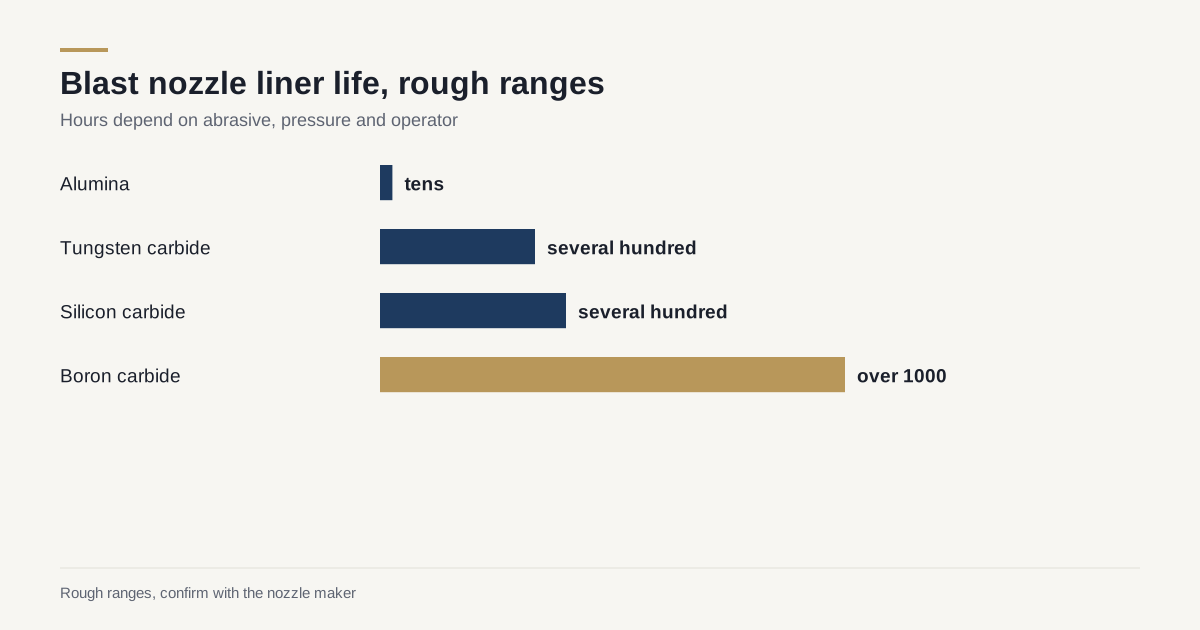
| Alumina | Short, tens of hours | Lowest cost | Wears fast with hard abrasives |
| Tungsten carbide | Several hundred hours | Tough, resists knocks | Heavy, cost, less hard than B4C |
| Silicon carbide | Several hundred hours | Hard, light | More brittle than carbide |
| Boron carbide | Well over a thousand hours | Hardest, lightest, slowest wear | Highest cost, brittle |
These figures are rough ranges reported by nozzle producers. Life depends on the abrasive type, the air pressure, the angle and the operator. Ask for figures that match your own conditions. For how the materials compare as wear parts more broadly, see ceramic, carbide or hardened steel for wear parts.
Why the cost per hour matters
A boron carbide liner costs several times a tungsten carbide one. If it lasts four or five times as long, the cost per hour comes out lower and there is an added gain: fewer stops to change nozzles and more consistent blast pressure and size throughout the life. In contrast, a rough job with a soft abrasive and many nozzle knocks may favour a tough tungsten carbide liner. Add up the whole cost, including the labour and idle time of changing nozzles, not only the price on the invoice.
Bore shapes
- Straight bore. A simple tube. Lower particle speed. Often used for small spot work.
- Venturi bore. A converging inlet, a short straight throat and a diverging outlet. It accelerates the particles and widens the blast pattern, raising productivity on large surfaces.
- Double venturi. An extra expansion stage. Used where a wide, even pattern matters.
- Fan pattern. A rectangular outlet for covering strips.
The inside shape is ground in the liner or formed in the green stage and finished with diamond. The more complex the shape, the more it costs. Surface finish in the throat affects wear: a smooth bore wears more evenly. See how diamond grinding works.
Spray nozzles and orifices
In spraying, the ceramic is usually a small insert, a disc with a precision hole, in a metal or plastic body. The hole sets the flow rate and spray angle.
- Agricultural and chemical spraying. Alumina and zirconia inserts keep their orifice size against fertiliser and pesticide slurries. Brass or plastic wear out in a season.
- Paint and coating. Hard orifices hold the atomisation pattern against abrasive pigments.
- Cleaning and descaling. Ceramic inserts last under high pressure water with grit.
- Welding gas cups. Alumina cups guide the shielding gas, withstanding the heat. They suffer from thermal shock if cooled suddenly, so silicon nitride is used in severe cases. See ceramic thermal shock testing.
Zirconia suits orifices where toughness helps with handling. Alumina is the economic choice for moderate duty. Silicon carbide and silicon nitride suit extreme abrasion or temperature. See zirconia grades explained if you are choosing between grades.
Fitting the liner in its housing
A ceramic liner rarely stands alone. It sits in a housing, usually aluminium or steel, with a cushion between them. Details that matter:
- Cushion layer. A rubber or polymer sleeve protects the liner from shock and takes up expansion differences.
- Clamping. The liner must be supported, not squeezed hard at a point.
- Thread and coupling. The holder threads on to the blast hose, and the thread is a weak point, not in the ceramic.
- Seal at the inlet. A leaking inlet lets air bypass the liner and wears the housing.
- Tolerance on outer diameter. A tight fit with a small, even gap to the cushion is better than a rigid press fit.
How to tell when a blast nozzle is due for replacement
A simple routine saves a lot of money.
- Gauge the bore. A set of drill-sized gauges or a go and no-go pin shows how much the throat has grown. Many shops replace the nozzle when the bore is one size larger than new, which is often 1.5 to 3 mm depending on the nozzle size.
- Watch the pressure at the nozzle. A pressure gauge near the nozzle shows a drop as the bore widens and air escapes more freely. A drop of 10 psi or more from the starting value is a common replacement sign.
- Check the liner for cracks and chips. A cracked liner wears unevenly and may shed pieces into the blast stream.
- Check the outlet end. A rounded or chipped outlet gives a poor pattern even when the throat is still in size.
- Log hours. A simple log of nozzle hours shows which liner material gives the lowest cost on your abrasive, which the datasheet cannot.
A worked example
A fabrication shop blasts steel with a hard aluminium oxide abrasive. It uses alumina nozzles because they are cheap, and changes them every day. The cost of the nozzle is small, but the crew spends time swapping them, and the blast pressure falls over the shift as the bore opens up. The shop trials a boron carbide liner. It costs many times as much per nozzle and lasts for weeks. The shop saves nozzle changes, keeps a steady pressure and finishes jobs faster. The cost per blasting hour is lower, although the invoice for one nozzle looks alarming.
A different shop blasts light rust with a soft media at low pressure. Its alumina nozzles last for weeks. Boron carbide would cost more and last no longer than the rest of the equipment. Both shops chose correctly for their duty. The right nozzle is the one that gives the lowest total cost under your own conditions.
What goes wrong
- Cracking from impact. A dropped nozzle breaks the liner. Use a cover or cushion and train the operators.
- Hot spot and flame damage in welding cups from rapid temperature change.
- Uneven wear because of an off-centre bore or an eccentric fit in the housing.
- Using a hard liner with a soft abrasive that does not justify it, or the opposite.
- Late replacement. A worn bore wastes air and abrasive, so the loss may exceed the saving on the nozzle.
Checklist for the RFQ
- Application: blasting, spraying, welding or other.
- Abrasive type and size, or fluid and solids content.
- Operating pressure and flow.
- Bore profile: inlet, throat length and diameter, outlet.
- Liner material, or the life target so the shop can propose one.
- Outer dimensions and fit to the housing.
- Quantity per year and target price per liner.
- Whether the shop supplies the housing and cushion or only the ceramic.
To find shops that make wear-resistant nozzle liners, send a drawing and the duty through the RFQ page.
Frequently asked questions
Which ceramic lasts longest in an abrasive blast nozzle?
Boron carbide wears slowest, silicon carbide sits in the middle and alumina wears fastest. Published life figures run from tens of hours for alumina to more than a thousand for boron carbide, but they depend on the abrasive, the pressure and the operator, so ask for figures on your own media.
Why does a worn blast nozzle cost money even before it fails?
As the bore widens, the air consumption goes up and the blast pattern and speed change, so the work gets slower and uses more compressor power and abrasive. A nozzle replaced late can cost more than a nozzle replaced early.
Can a ceramic nozzle be used for spraying paint or chemicals?
Yes. Ceramic orifices and inserts keep their size under abrasive pigments and fertilisers far longer than brass or steel, so the spray pattern and the flow rate stay stable between replacements.
Need a quote for this part?
Send the drawing. We match you with up to 3 shops that grind this grade and reply within 24 business hours.
Get matched with a ceramic shop