Guides / Process
Post-Grinding Anneal for Ceramics: When It Helps and When It Wastes a Cycle
October 5, 2026
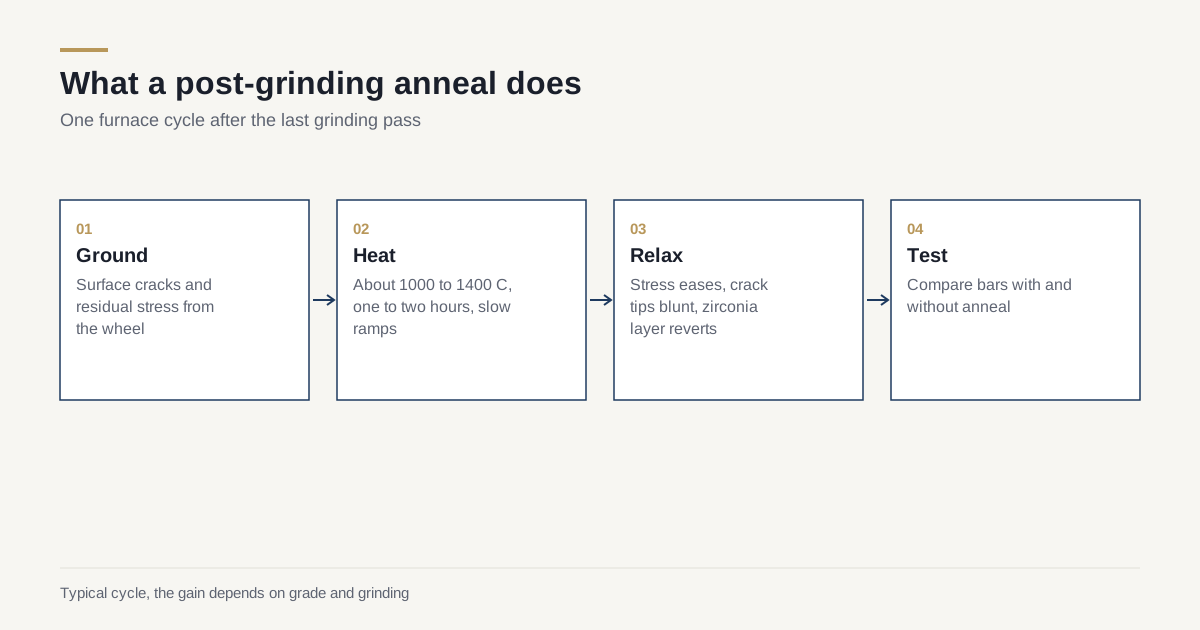
Diamond grinding is how most dense ceramic parts reach their final shape, and it leaves its mark. The wheel cuts by cracking and crushing tiny fragments away, so the surface carries a thin damaged layer with small cracks and residual stress. A short furnace cycle afterwards, called an anneal, is sometimes used to repair or relax that layer.
Whether it is worth the cost is not a yes or no question. It depends on the material, on how aggressive the grinding was and on what the part has to do. This guide sets out the effects so that you can decide.
What grinding leaves behind
A ground ceramic surface has three kinds of change:
- Surface cracks. Fine cracks, usually a few micrometres to tens of micrometres deep. They sit in the direction of the wheel motion and act as the strength-limiting flaws.
- Residual stress. Often a thin compressive layer from plastic deformation at the surface, with balancing tension below. Compressive stress at the surface can help strength.
- Phase change. In zirconia, grinding can turn some of the tetragonal phase at the surface into monoclinic. That change expands the surface layer and creates compression, but it also leaves the part with a layer of different composition.
How aggressive the grinding was decides how deep and how severe these layers are. Fine finishing passes with fine wheels leave less damage than rough passes with coarse wheels. See how diamond grinding works for the stages.
What an anneal can do
Heating the part to a temperature well below its sintering point, typically around 1000 to 1400 degrees C depending on the material, for an hour or two in air, can produce four effects.
- Relieve stress. Thermal energy lets residual stress relax.
- Blunt or heal cracks. Mass transport at the crack tip rounds the tip and, in some bodies with a small glassy phase, can partly close the crack.
- Reverse a phase change. In zirconia, the monoclinic layer from grinding can revert to tetragonal on heating.
- Oxidise. In silicon nitride and silicon carbide, a thin silica film forms in air and can seal small surface flaws.
The effect on strength is not guaranteed, because removing the compressive layer takes away a benefit as well as a flaw.
Typical outcomes by material
| Material | Typical anneal | Reported outcome | Notes |
|---|---|---|---|
| Alumina | 1200 to 1400 degrees C, 1 to 2 hours | Strength change small to moderate, depends on grinding | Can relax stress and heal fine flaws |
| Y-TZP zirconia | 900 to 1200 degrees C, 1 to 2 hours | Reverses surface monoclinic layer | May lower strength if the compressive layer was helping |
| Silicon nitride | 1000 to 1300 degrees C in air | Oxide film can heal small flaws | Watch film thickness on tight tolerance parts |
| Sintered silicon carbide | 1000 to 1300 degrees C in air | Small effect | Heavy grinding damage may be the real issue |
These are typical ranges from published work and shop practice. They are not a promise of any strength gain, and cycles differ by producer.
Where it helps
- Parts ground aggressively. If a part had a rough stock removal and a short finish, an anneal may recover some of the lost strength.
- Zirconia with a phase problem. A zirconia part that must stay phase stable in a hot or wet environment may need the monoclinic layer reversed. See zirconia ageing and low temperature degradation.
- Parts with high stress or fatigue requirements. Where the failure mode is a surface crack growing under cycles, small improvements in surface condition pay back.
- Parts that will be thermally cycled in service. An anneal at a temperature above the service maximum can prevent later changes in the part from showing up in the field.
Where it does not
- Static insulators and fixtures. No load, no benefit.
- Parts finished with fine lapping. A lapped or polished surface already has very little damage, and an anneal adds a process step without a gain.
- Parts with metallisation, brazing or sensitive coatings. The furnace cycle can harm them. Sequence the anneal before those steps. See metallising and brazing ceramic to metal.
- Parts with very tight dimensions. Oxide films and tiny phase changes can move dimensions by micrometres.
What a typical cycle looks like
The cycle is simple but the details matter.
- Ramp up slowly. Ceramic parts crack from thermal shock on the way up as well as on the way down, so the ramp is usually a few degrees per minute for thick or complex parts.
- Hold. One to two hours at temperature is common. Longer holds add grain growth and oxidation without much extra benefit.
- Atmosphere. Air for oxides. For nitrides and carbides, air gives an oxide film, while an inert gas avoids it. Choose according to whether the film is wanted.
- Cool slowly. Furnace cooling is the safe default.
- Support. The part sits on a clean setter plate of a compatible material. A dirty setter leaves marks or reacts with the surface.
Risks of the anneal itself
An anneal is a heat treatment, and every heat treatment can go wrong.
- Contamination. Furnaces shared with other work can deposit salts or metals on the surface. In semiconductor and medical work, that is a serious concern. Ask whether the furnace is dedicated.
- Discolouration. Oxide parts can change colour slightly, and silicon nitride gets an iridescent film.
- Warp. A thin, long part can sag if it is not supported along its length.
- Lost compressive layer. In some alumina and zirconia grades the as-ground compressive layer is a real benefit. Removing it can cost strength.
A short worked example
Take a 5 mm diameter zirconia pin, ground with a fairly coarse wheel to save time, used in a fatigue application with a wet and warm environment. Test bars cut from the same lot show an average strength a little lower than the datasheet, and the scatter is wide. The shop adds a finishing pass with a fine wheel and a short anneal. The next lot of bars shows a higher average and a much narrower scatter. The gain here comes from both changes together, and the shop cannot say how much belongs to each. A cleaner experiment would change one step at a time. That is the point of testing bars before committing to a route: the data tells you which step to keep.
A cheaper first step
Before adding a furnace cycle, ask whether better grinding gives the same result. A finishing sequence with a finer wheel, lower infeed and plenty of coolant often removes the need. Lapping or polishing the critical face can remove the damaged layer entirely, see lapping, polishing and flatness. Compared with those, an anneal is a lever that changes the damage in place instead of removing it.
How to decide with data
- Make test bars or a sample of the real part by the real grinding route.
- Test strength on bars ground and annealed, and on bars ground only.
- Compare average and scatter, not only the average.
- Check dimensions before and after on a sample.
- Decide whether the gain is worth the cost and the extra week.
Do not rely on a published gain from a different material or a different grinding method.
What to write on the RFQ
- State the strength or fatigue requirement and how it will be verified.
- Say whether post-grinding anneal is required, allowed or forbidden.
- Specify the sequence if metallising, glazing or coating also applies.
- Give the maximum service temperature, so the shop can choose an anneal above it if needed.
- Ask the shop to state the grinding route, not just the heat treatment.
To discuss it with shops that run furnace cycles on ground parts, add the requirement to your RFQ.
Frequently asked questions
Does annealing always increase the strength of a ground ceramic?
No. Published results vary with the material and with how hard the part was ground. In some cases strength rises, in others it stays the same and in a few it falls because a helpful compressive layer is removed. Test bars from your own process are the only reliable answer.
Will a post-grinding anneal change the dimensions?
For dense ceramics, almost not at all, since the part is far below its sintering temperature. Surface oxidation or a tiny change in a transformed layer can alter dimensions by micrometres, which matters only on very tight parts.
Can I anneal a part that has a metallised layer or a braze joint?
Only if the anneal temperature and atmosphere are below what the metallisation and joint can take. A furnace cycle in air can oxidise a metallised layer, so sequence the anneal before metallising.
Need a quote for this part?
Send the drawing. We match you with up to 3 shops that grind this grade and reply within 24 business hours.
Get matched with a ceramic shop