Home / Types of technical ceramics
Types of Technical Ceramics
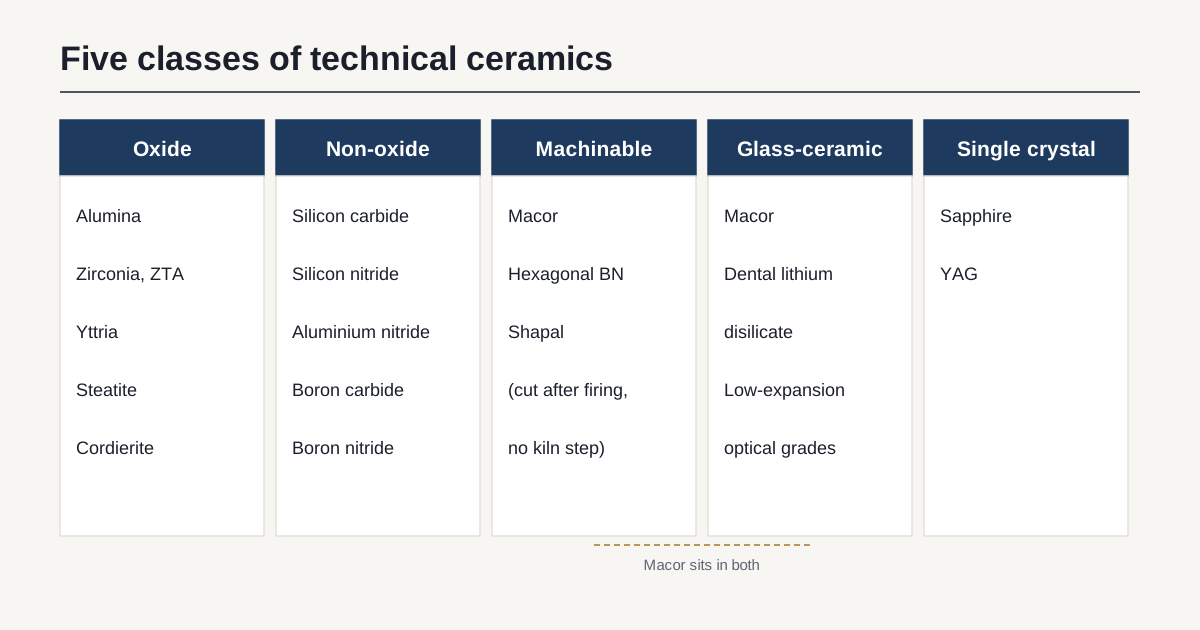
Technical ceramics fall into five classes: oxide, non-oxide, machinable, glass-ceramic and single crystal. The class tells you how the material is made, how it is machined, what it roughly costs and which failure it resists. Pick the class first, then the grade inside it.
The five classes at a glance
Typical grades and behaviour, not a rule for any one blank. Full property data by grade is on the materials page.
| Class | Bonding | Common grades | How it is made | Strong at | Weak at | Cost tier |
|---|---|---|---|---|---|---|
| Oxide | Mostly ionic | Alumina 96 to 99.8%, zirconia (3Y-TZP, Mg-PSZ), ZTA, ATZ, yttria, steatite, forsterite, cordierite, mullite | Sintered in air | Insulation, chemical stability in air, wide supply | Lower thermal conductivity (except BeO), thermal shock in dense alumina | Low to medium |
| Non-oxide | Mostly covalent | Silicon carbide (sintered, reaction bonded), silicon nitride, aluminium nitride, boron carbide, boron nitride | Inert gas, nitrogen or vacuum; some routes use pressure or reaction bonding | Hardness, stiffness, heat conduction, thermal shock (Si3N4) | Oxidation at high temperature in air, AlN reacts with moisture, higher blank cost | Medium to high |
| Machinable | Mixed | Macor glass-ceramic, hexagonal boron nitride, Shapal Hi M Soft (machinable AlN) | Already fired; machined in the final state with carbide tools | No firing after machining, fast prototypes, complex shapes | Low strength and hardness, poor wear life | Material high, machining low |
| Glass-ceramic | Glass plus crystals | Macor (mica in a borosilicate glass), lithium disilicate for dental use, low-expansion optical grades | Melted as glass, then crystallised by heat treatment | Zero porosity, sealable to glass and metal | Lower temperature limit than sintered ceramics | Medium |
| Single crystal | One crystal, no grain boundaries | Sapphire (single-crystal alumina), single-crystal yttrium aluminium garnet | Grown from the melt | Transparency, hardness, purity, smooth polish | Orientation-dependent properties, slow growth, cost | High |
Typical property ranges by class
Ranges cover common commercial grades in each class. Typical values, confirm with the supplier's datasheet for the blank you will receive.
| Property | Oxide | Non-oxide | Machinable | Sapphire |
|---|---|---|---|---|
| Density, g/cm3 | 2.3 to 6.1 | 2.1 to 3.3 | 1.9 to 2.9 | 3.98 |
| Flexural strength, MPa | 110 to 1,200 | 300 to 1,000 | 30 to 300 | 400 to 1,000 depending on orientation and finish |
| Hardness HV | 700 to 1,600 | 1,100 to 3,000 (hexagonal BN far softer) | 250 to 400 (Knoop for Macor) | About 2,000 |
| Thermal conductivity, W/mK | 2 to 33 | 20 to 180 | 1.5 to 90 | About 35 to 42 |
| Electrical behaviour | Insulator | Insulator (Si3N4, AlN, BN) or semiconducting (SiC) | Insulator | Insulator |
How the classes relate
The classes describe chemistry and manufacturing route, so they overlap at the edges.
Oxide and non-oxide is the main split. Oxides such as alumina and zirconia are fired in air, which keeps blanks cheap and supply wide. Non-oxides such as silicon carbide and silicon nitride need a protective atmosphere, pressure or a reaction-bonding route, so the blank costs more. In return they are harder, stiffer or better at moving heat. Composites cross the line: zirconia-toughened alumina is an oxide blend, and some silicon nitride grades carry oxide sintering aids.
Machinable is a route, not a chemistry. Macor is a glass-ceramic, hexagonal boron nitride is a non-oxide and Shapal is a machinable aluminium nitride. What they share is that a shop cuts them in the final state with carbide tools and no firing follows. Green machining of alumina or zirconia before sintering is different: the part still shrinks in the kiln and is usually ground after firing. See green machining against hard machining.
Glass-ceramics start as glass and are crystallised by heat treatment, so they have no porosity. Low-expansion optical glass-ceramics are a separate field with their own suppliers and are not covered here.
Single crystals such as sapphire have no grain boundaries. Their properties depend on the crystal orientation, which a polycrystalline alumina part does not have. The sapphire against alumina guide covers when that matters.
Choosing a class from the failure mode
Start from what goes wrong with the current part, not from the material on an old drawing.
- It must insulate and the budget is tightOxide: alumina 96% or 99.5%, steatite for low-voltage insulators.
- It breaks or chipsOxide with transformation toughening (3Y-TZP zirconia, ZTA), or silicon nitride from the non-oxides.
- It wears from abrasive slurry or gritNon-oxide: sintered silicon carbide or boron carbide.
- It must move heat and insulateNon-oxide: aluminium nitride. Silicon carbide moves heat but most grades do not insulate.
- It sees fast temperature changesSilicon nitride for loaded parts, cordierite for lightly loaded kiln and burner parts.
- You need ten parts next weekMachinable: Macor, boron nitride or Shapal, if strength and wear allow.
- It must be transparent or polish to a mirrorSingle crystal: sapphire.
When a ceramic class is the wrong answer
Under heavy impact, bending or point loads, hardened steel, carbide or a coated metal part often lasts longer and costs less than any ceramic class. Read ceramic against coated metal and ceramic, carbide or hardened steel before you commit. Property-first shortlists are in choosing a ceramic by property.
Questions about ceramic classes
Terms used here are defined in the glossary. Background reading: ceramic engineering.
What are the main types of technical ceramics?
Most buyers meet five classes: oxide ceramics such as alumina and zirconia, non-oxide ceramics such as silicon carbide, silicon nitride and aluminium nitride, machinable ceramics that are cut in their final state, glass-ceramics such as Macor, and single crystals such as sapphire. The class tells you how the material is made, what it costs and which properties to expect.
Is technical ceramic the same as advanced or fine ceramic?
They are names for the same family. ASTM committee C28 uses advanced ceramics, ISO technical committee 206 uses fine ceramics, and much of European industry says technical ceramics. All three mean engineered ceramics with controlled composition and microstructure, as opposed to traditional ceramics such as tile, brick and tableware.
Which class is cheapest to machine?
Per part, a machinable ceramic such as Macor is often cheapest for a prototype because it is cut with carbide tools and needs no firing. For volume, a pressed and sintered oxide such as 96% alumina is usually cheapest because the blank is cheap and much of the shape can be formed before firing.
Does the class decide the price of a ground part?
Partly. Blank cost rises from alumina to zirconia to the non-oxides, and diamond grinding time rises with hardness. Tolerance, the number of ground faces and the quantity still decide most of the quote. The cost guide covers the drivers.
Not sure which class fits?
Send the drawing and say what the part must survive. We match your RFQ with up to 3 shops that grind the grade and reply within 24 business hours.
Get matched with a ceramic shop